Retrograde Motion Is a Geocentric Effect
Planets normally creep eastward against the stars. Several times a year one of them slows, stops, runs backwards for a few weeks or months, stops again, and resumes. That is retrograde motion, and every astrological tradition takes it seriously.
Yet nothing has reversed: the planet keeps moving forward in its orbit the whole time.
What is actually happening
Picture two cars on a motorway, yours in the outside lane and a slower one in the inside lane. As you draw level and pass it, the slower car appears to slide backwards against the fields beyond, even though it is moving forward the whole time. Pull far enough ahead and it resumes its normal forward drift.
Retrograde motion works the same way. The Earth travels faster in its orbit than the outer planets do, and when it catches and overtakes one, that planet appears to slide backwards against the stars.
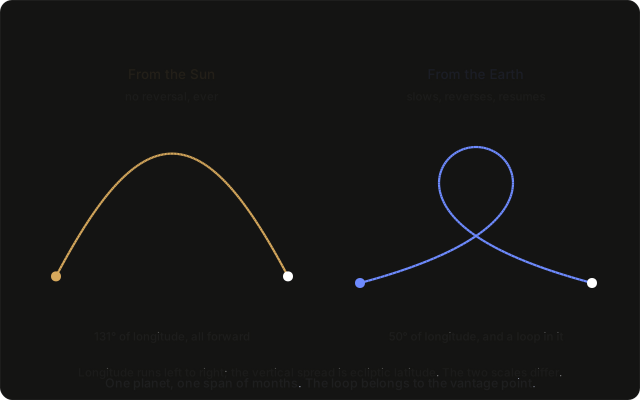
The two panels are the same planet over the same months. The path on the left is what Mars does. The loop on the right is what it looks like from a platform that is itself moving faster.
The inner planets do it too
Mercury and Venus are inside the Earth's orbit and move faster, so they do the overtaking. The geometry is reversed and the appearance is the same: as they sweep past between the Earth and the Sun, they run backwards against the stars.
Mercury does this three or four times a year, which is why it is the planet most associated with the phenomenon.
The test
If retrograde motion were a fact about the planet, it would show up wherever you measured from, and it does not.
Switch the origin to Heliocentric and every retrograde disappears.
Every planet moves steadily forward around the Sun, without exception. The loops are not smoothed out or reduced but absent, because there was never anything there to reduce. What vanished was the Earth's own motion, which had been mixed into every geocentric position because the observer was standing on it.
So the label follows the frame: a planet can be reported retrograde under the geocentric origin and never under the heliocentric one.
What this does not mean
The test settles two things, and they pull in opposite directions.
It does not make retrograde motion unreal. The appearance is as described, repeatable, predictable to the second, and identical for every observer on Earth. A tradition built on how the sky looks from here is entitled to a phenomenon that is how the sky looks from here. "Optical illusion" is the usual phrase for it, and an illusion that every human being shares and that recurs on schedule is a sound thing to reason about.
It does mean the effect belongs to the vantage point. Retrograde motion is a statement about the relationship between the Earth and another planet — about overtaking — and not a statement about the other planet alone. That is a substantial claim in its own right, and arguably a more interesting one.
Some questions exist in only one frame
A question can be perfectly well formed and still have no answer in the frame it is asked in.
Ask for the retrograde stations of Mars measured from the Sun and nothing goes wrong with the arithmetic. The calculation returns nothing, however long a span it is given, because in that frame no planet ever stops.
The same holds for anything defined by being seen from the Earth: lunar phases, which are about how the Moon is lit as seen from here, and heliacal events, which are about when a body first becomes visible in twilight to somebody standing on the ground. Asked from the Sun, none of them mean anything.
This is why software that offers all three origins will often withhold the heliocentric one for these particular calculations. The restriction does not come from the arithmetic. The question has no meaning as asked, so there is nothing to answer.
What comes next
The last page of the category sets the three origins side by side: what each one describes, and what changes between them.
Next: The Three Origins Compared.