Ecliptic Coordinates
Ecliptic is the first of the two settings, and the default. It measures along and away from the ecliptic.
Two angles
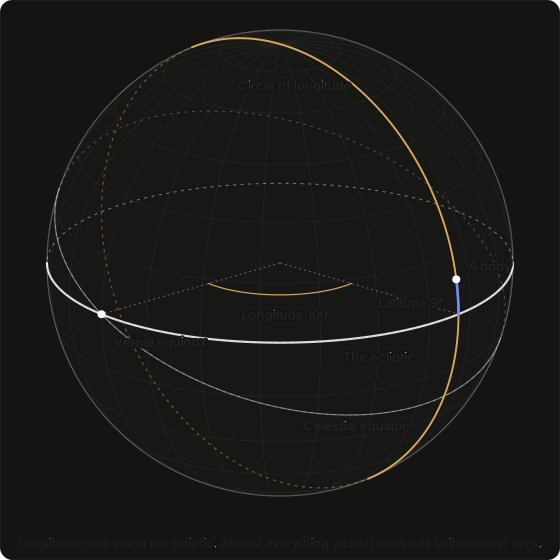
- Celestial longitude is the angle eastward along the ecliptic, starting from the vernal equinox, from 0° to 360°.
- Celestial latitude is the angle perpendicular to the ecliptic, positive north of it and negative south, from 0° to ±90°.
Both are quoted in degrees.
Two pairs of names are easy to confuse:
- "Celestial latitude" is not declination. Declination is measured from the celestial equator; celestial latitude from the ecliptic. Same idea, different reference plane, different value for the same body.
- "Celestial longitude" is not right ascension, for the same reason.
Where confusion is possible, this is why the words ecliptic and equatorial get attached.
Why one number is usually enough
Everything a chart plots stays close to the ecliptic. The planets orbit in roughly the Earth's own plane, so their celestial latitude rarely exceeds a few degrees. The Moon reaches about 5°. The Sun's celestial latitude is as near zero as any chart will ever show, because the ecliptic is defined as the Sun's path — not exactly zero, since a modern ephemeris has the Sun straying from its own line by around an arcsecond, but no chart will ever print the difference.
So for the bodies that matter, celestial latitude hovers near nothing and carries little information. Longitude does the work, and a single number locates a body well enough for most purposes.
This is why astrological positions are quoted as one figure. A chart saying the Sun is at 15° Taurus is giving a celestial longitude and silently dropping a latitude that is either zero or nearly so.
The diagram above exaggerates for legibility: a latitude of 9° is larger than almost anything you will meet in practice.
That dropped latitude is not harmless. It is small, and it is not zero, and the whole of Why the Same Degree Arrives at Two Different Times is about what a few degrees of it can do.
The signs are longitude
The zodiac signs are not a separate scheme layered on top. They are celestial longitude, divided into twelve equal 30° arcs starting at the vernal equinox, and named:
| Sign | Celestial longitude |
|---|---|
| Aries | 0° – 30° |
| Taurus | 30° – 60° |
| Gemini | 60° – 90° |
| Cancer | 90° – 120° |
| Leo | 120° – 150° |
| Virgo | 150° – 180° |
| Libra | 180° – 210° |
| Scorpio | 210° – 240° |
| Sagittarius | 240° – 270° |
| Capricorn | 270° – 300° |
| Aquarius | 300° – 330° |
| Pisces | 330° – 360° |
So "15° Taurus" means celestial longitude 45°, and the two notations are interchangeable. Reading a chart position is reading a longitude in a different alphabet.
Note where the signs live: on the ecliptic, and nowhere else. They are divisions of this plane. Here that goes without saying; a later page in this category, Why Signs Don't Apply to Right Ascension, turns on it.
Two ways to write the same position
Under the Ecliptic plane a position can be written either as a sign coordinate —
15°Tau37' — or as a cycle angle, the same value as plain decimal degrees around
the full circle: 45.616°.
Both are the same number. One is written in the zodiac's alphabet and the other is not.
What comes next
The next page describes the other frame, which is built on the Earth's rotation rather than its orbit.
Next: Equatorial Coordinates.