Projecting Between the Planes
This page has one idea in it, and the idea is easiest to see as a fence.
The fence
Picture a fence running across a field, with palings standing a degree apart. The palings are numbered and perpendicular to the base of the fence.
A planet hovers in the air above the fence — not sitting on it, floating some distance above. You want to know which degree it occupies, so you extend the palings upward until one of them reaches the planet. The number on that paling is the reading.

Leave the planet exactly where it is. Do not move it by a hair. Instead tilt the fence by 23.4°, hinged at one end, and extend the palings again.
The planet now reads a different degree.
Nothing about the planet changed. What changed is the thing you were measuring it against — and since a coordinate is a statement about a body relative to a reference, moving the reference moves the coordinate.
That is the whole of projection between the two planes. The ecliptic is one fence, the celestial equator is the other, and 23.4° is the angle between them.
The palings are the projection
The palings need a name, because they do the work of the projection.
Each paling is the set of points that all share one reading — every position that projects down onto the same mark on the fence. In the sky they are great circles running from pole to pole of whichever plane you are using: hour circles through the celestial poles for the equatorial frame, and the corresponding circles through the ecliptic poles for the ecliptic frame.
They cannot be the same palings for both fences, and the poles are the reason. As the obliquity page showed, the two planes have different poles, 23.4° apart. Palings run to the poles, so different poles mean different palings. Tilt the fence and its whole family of palings tilts with it.
This is what lies behind "measure away from the plane". Both frames measure away from their own plane towards their own pole, and those are two different directions.
Where the hinge is
The fence is hinged, and the position of the hinge decides which bodies move when it tilts.
The two planes cross at the vernal equinox and at the point opposite it. That crossing line is the hinge: the axis the tilt turns about. Along that line the two fences are in exactly the same place, because that is what crossing means.
So a body lying on the hinge reads the same in both frames, as it must, and everything away from the hinge swings.
The two ways a body can be off the hinge
Everything in the next page follows from asking where a body sits relative to that hinge, and there are two independent ways to be away from it.
Along the fence. A body can be sitting right on the fence — flat on it, no height at all — but a long way from the hinge. Tilting the fence still moves it, because it swings up or down and its perpendicular meets the fence somewhere new. A body on the ecliptic at 45° of longitude reads about 42.5° of right ascension: the same point in the sky, two and a half degrees apart in the two frames. This effect is largest around 45°, 135°, 225° and 315°, and it drops to nothing at 0°, 90°, 180° and 270°.
Above the fence. A body can be hovering, at some celestial latitude, and this is the case the diagram draws. Now even being directly over the hinge does not keep its reading fixed, because it is over the hinge rather than on it. When the fence swings beneath it, the planet stays put and the palings move under it.
A body hovering a height h above the hinge ends up displaced along the fence by h × sin(23.4°). That factor is 0.398, or about four-tenths. It is the sine of the tilt, and the fence shows why it appears.
The same thing on a sphere
The fence is flat and the sky is not. On the sphere the picture is the same, with great circles in place of the fence.
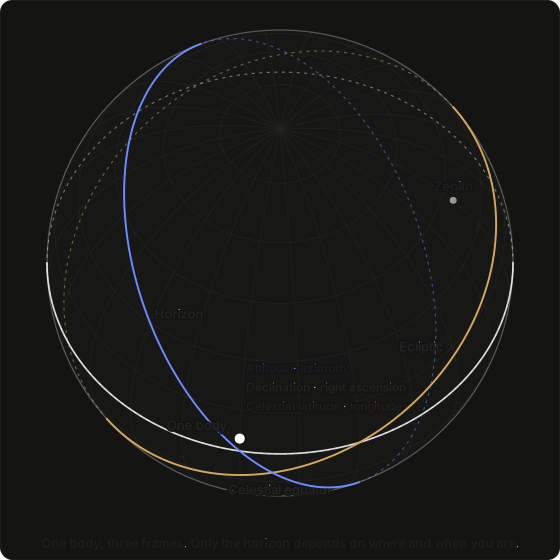
One body, sitting still, carries three different pairs of numbers. The two circles that concern this category are the equator and the ecliptic; the third is the horizon, included as a reminder that the same machinery built your local frame too.
None of the three readings is the correct one; each is a reading against a different fence.
Latitude and declination are not the same number
One consequence is worth stating before the next page, because the two numbers are easily confused.
A body's celestial latitude is its height above the ecliptic. Its declination is its height above the celestial equator. The two fences give two heights, and they are different numbers.
The Sun is the cleanest demonstration. Its celestial latitude is essentially zero all year — it lies on the ecliptic by definition. Its declination swings from +23.4° to −23.4° and back. For the same body and the same motion, one frame reports a constant while the other reports the whole mechanism of the seasons.
What comes next
A planet is not a fixed dot. It is moving along the fence, so if the two frames disagree about which degree it is at, they also disagree about when it arrives at any given degree. The next page measures that disagreement. For the slowest bodies it amounts to years, and the fence explains why.