The Obliquity of the Ecliptic
The celestial equator and the ecliptic are both great circles on the same sphere, and they do not coincide. The angle between them is the obliquity of the ecliptic, currently about 23.4°.
A good deal depends on that one number, including everything in the rest of this category.
Where the tilt comes from
The celestial equator is the Earth's equator projected outward. The ecliptic is the Earth's orbital plane projected outward. So the angle between them is the angle between the Earth's equator and its orbit — which is to say, the tilt of the Earth's axis relative to the plane it travels in.
The Earth does not spin upright in its orbit. It leans by 23.4°, and it keeps leaning in the same direction all year round.
The same angle, in two places
The tilt shows up wherever the two circles are compared, and the diagram shows it in two places at once.
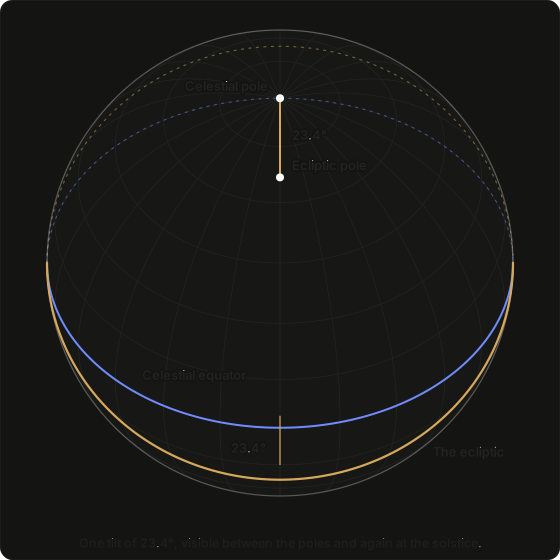
Near the top, the celestial pole and the ecliptic pole are separated by 23.4°. Each plane has its own pair of poles, and tilting a circle tilts its poles by the same amount.
Near the bottom, the celestial equator and the ecliptic are separated by 23.4° at the solstice, where the gap between them is widest.
These are not two facts but one tilt, measured in two places, and that is why the figure is drawn from this direction.
Hold on to the top half of that figure. The two frames have different poles, 23.4° apart — and since "measure away from the plane" means "measure towards its pole", two frames with different poles measure away in different directions. Everything from Projecting Between the Planes onwards is built on that difference.
What follows from it
The Sun's declination varies. As the Sun travels the ecliptic it is carried from 23.4° north of the celestial equator at the June solstice, down through zero at each equinox, to 23.4° south at the December solstice. Its declination is never outside that range, which means that the Sun has a celestial latitude of zero and a declination that swings across 47°. The two frames describe the same body's motion in two quite different ways.
The seasons. A body's declination determines how high it climbs and how long it stays up. So as the Sun's declination swings through the year, the northern hemisphere gets a high, long-lasting Sun in June and a low, brief one in December — and the southern hemisphere gets the reverse, at the same time, from the same cause.
The seasons do not come from changes in the Earth's distance from the Sun. The Earth is in fact slightly closer to the Sun in January. They come from the tilt.
The tropics and the polar circles. The Sun can only stand directly overhead where its maximum declination reaches, and it becomes circumpolar 23.4° short of the pole. Both limits are the obliquity, measured from opposite ends.
| Feature | Latitude | Comes from |
|---|---|---|
| Tropic of Cancer | 23.4° N | the obliquity, from the equator |
| Tropic of Capricorn | 23.4° S | the obliquity, from the equator |
| Arctic Circle | 66.6° N | the obliquity, from the pole |
| Antarctic Circle | 66.6° S | the obliquity, from the pole |
Those are the two numbers left outstanding by The Zenith and the Nadir and Sky That Never Sets.
Unequal rising times. Because the ecliptic is tilted, its twelve equal divisions do not meet the horizon at equal angles. Some parts rise steeply and quickly, others at a shallow angle and slowly. Equal stretches of ecliptic take markedly unequal times to rise, which is why the Ascendant moves through the signs at such uneven speed.
The value is not permanent
23.4° is the current figure, not a constant. The obliquity oscillates slowly, between roughly 22.0° and 24.5°, over a cycle of about 41,000 years. It is presently decreasing by about 47 arcseconds per century.
Over a human lifetime that is negligible. Over the span covered by historical astronomy it is not: the obliquity was noticeably larger in antiquity, and ancient measurements of it are consistent with modern ones once the drift is accounted for.
What comes next
With the tilt described, the next two pages take each frame in turn, starting with the ecliptic frame, the one astrology is written in.
Next: Ecliptic Coordinates.