Sky That Never Sets, Sky That Never Rises
Some stars never set: they circle the pole all night, dipping towards the northern horizon and climbing again without ever touching it.
These are circumpolar stars, and which ones qualify depends entirely on where you are standing. Like the rest of this site, the page is written for a northern-hemisphere observer; stand south of the equator and the same story plays out around the south celestial pole.
A cap of sky, the size of your latitude
The circumpolar stars occupy a circular region of sky centred on the celestial pole. That region has an exact size:
The circumpolar cap reaches as far from the pole as your latitude.
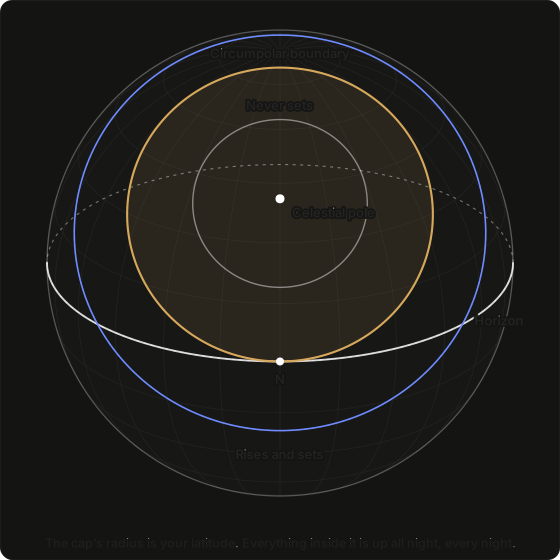
The reason is visible in the figure, and it comes entirely from the previous page's rule. Your celestial pole sits at an altitude equal to your latitude. Any circle drawn about the pole with a radius smaller than that altitude cannot reach down to the horizon. A circle with radius exactly equal to it just grazes the horizon at the north point, and anything larger cuts through and sets.
The other cap
The same argument runs upside down at the other end.
There is a matching region around the opposite celestial pole, exactly the same size, containing sky that never rises for you at any hour or in any season.
Between the two caps lies the band that rises and sets, and that band is what most people think of as "the sky".
Latitude changes what sky exists for you
Because both caps are the size of your latitude, moving north or south does more than shift what you see; it changes how much of the sky is available to you at all:
| Where you stand | Circumpolar cap | Never rises | Visible over a year, by area |
|---|---|---|---|
| North pole (90°) | Half the sky | The other half | Half |
| 60° N | Large | Large | Three-quarters |
| 41° N | Moderate | Moderate | About seven-eighths |
| Equator (0°) | Nothing | Nothing | The whole sky |
The fractions measure area — how much of the whole celestial sphere ever shows itself. The caps sit at the poles, where the sphere narrows, so even a broad cap covers less sky than its reach suggests: at 41° north the never-rises cap spans 41°, yet holds only about an eighth of the sky.
This is why the Southern Cross cannot be seen from London or New York, and why Polaris is invisible from Sydney. Neither is a matter of season or timing; both are permanent consequences of latitude.
The midnight Sun
The Sun obeys the same rule, and because its distance from the celestial equator changes through the year, it can move in and out of the circumpolar condition.
Above latitude 66.6° — the Arctic Circle — there are days around the June solstice when the Sun sits far enough north of the celestial equator to be circumpolar. It circles the sky without setting: the midnight Sun.
Six months later the same latitude has the reverse. The Sun sits far enough south to fall in the never-rises cap, and it stays below the horizon for days or weeks — the polar night.
Both are the ordinary circumpolar rule applied to a body whose position changes through the year. Why the Arctic Circle falls at 66.6°, and why the Sun's position relative to the equator swings at all, comes out of the 23.4° tilt taken up in The Obliquity of the Ecliptic.
A body's distance north or south of the celestial equator has a name — declination — and it is the measurement that decides all of this. It gets its proper introduction in Equatorial Coordinates, in the last category on this site.
The category in one paragraph
A location is two angles, a height and a time zone. The two angles do nearly all the work: latitude fixes how the sky is tilted above you and therefore what you can ever see, longitude fixes what time it is and therefore which part of that sky is overhead. The height changes almost nothing, and the time zone changes no astronomy at all — it only decides which instant a clock reading refers to. From those, and from the Earth's own rotation, come your horizon, your zenith, your meridian, the celestial poles and the celestial equator: the complete frame that every later page measures against.
What comes next
The frame is now complete, but nothing has yet been measured in it.
The next category takes up the first of the three remaining settings, the zodiac. It asks where the count starts when a position is given as a degree of a sign, and why there is more than one answer.
Next: What a Zodiac Is.