North, South, and the Meridian
A horizon and a zenith give you a frame, but not yet a way to point. Saying a star is 30° above the horizon does not say which way to turn to see it. For that, the horizon needs marks on it.
Four points on the horizon
The horizon is marked with four cardinal points: north, east, south and west, spaced 90° apart around the circle.
North is the one that has to be pinned down first; the other three follow from it. Astronomically it comes from the Earth's rotation, because the rotation is what fixes the poles:
The north point is where your meridian of longitude, continued along the ground in the direction of the Earth's north pole, meets your horizon.
Turn to face it and east is on your right, south behind you, west on your left.
This is true north, which is not the direction a compass shows. A compass needle points to the magnetic pole, which sits some distance from the rotational pole and drifts year by year. The gap between them — the magnetic declination — can be a few degrees or a great many depending on where you are. The word declination returns later on this site with a different, celestial meaning; the two uses are unrelated. Astronomy always means true north.
The meridian
Now take the two things you already have — the north and south points on the horizon, and the zenith overhead — and pass a circle through all three.
That circle is your meridian. It runs from the north point on the horizon, up across the sky through the zenith, down to the south point, and continues around beneath you through the nadir. Like the horizon, it is a great circle: its plane passes through you at the centre.
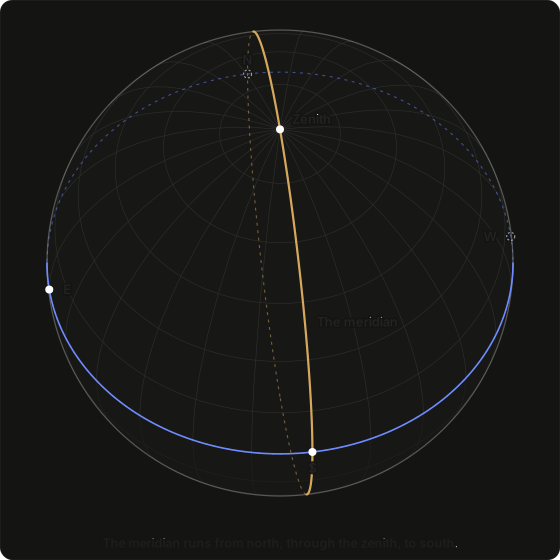
The gold circle is the meridian, the blue one the horizon. The four cardinal points sit on the horizon where you would expect — and two of them, north and west, fall on the far side of the sphere, which is why they sit on the dashed half of the circle. They are no less real for being behind you.
Follow the gold circle below the south point and it keeps going, down past the horizon towards the nadir. The meridian is a complete circle, and half of it is always beneath your feet.
Why the meridian matters
The meridian matters because it splits the sky into an eastern half and a western half. Because the Earth turns steadily from west to east, every body in the sky makes the same journey through those halves:
- It rises somewhere on the eastern part of the horizon.
- It climbs through the eastern half of the sky.
- It crosses the meridian — the moment it is due north or due south of you, and at its highest point of the day. This is called culmination.
- It descends through the western half.
- It sets somewhere on the western part of the horizon.
Every body that rises and sets does this, every day, in that order. When the Sun crosses your meridian, it is local noon. The meridian is the sky's dividing line between "still climbing" and "on the way down", which makes it the most useful circle for questions about timing.
The same word, twice
You have met the word meridian once already, in Latitude and Longitude, where a meridian of longitude was a half-circle running pole to pole on the Earth's surface. The shared name is not a coincidence.
Your meridian of longitude on the ground, and your meridian in the sky, lie in the same plane. Take the half-circle of longitude running through your location, extend its plane outward until it reaches the sky, and what it traces there is your celestial meridian. One is the Earth-bound version, one the sky-bound version, of a single flat surface containing you, both poles, and the centre of the planet.
That is the thread tying this category together: your position on the Earth determines your horizon, your zenith, and your meridian, and those three between them determine everything you can say about where a body sits in your sky.
Azimuth
One convention from this frame is worth meeting now. Azimuth is how direction along the horizon gets a number: an angle measured around the horizon starting from north and running eastward, all the way round.
| Direction | Azimuth |
|---|---|
| North | 0° |
| East | 90° |
| South | 180° |
| West | 270° |
Azimuth and altitude together pin down any point in your local sky — one angle around, one angle up.
What comes next
You now have a complete local frame: a horizon to bound the sky, a zenith to centre it, cardinal points to orient it, and a meridian to divide it. Every part of it was built from your latitude and longitude.
What it does not yet have is anything fixed in the sky it is looking at. The sky needs reference marks of its own, ones that do not move when you do, and the next page describes them.