The Time Zone in a Location
The pages so far have been about astronomy. This one is about how people have agreed to set their clocks, and it belongs here because those agreements are where charts most often go wrong.
Local time is a matter of longitude
Noon is when the Sun crosses your meridian, and observers at different longitudes reach that moment at different instants.
The rate follows from the Earth turning 360° in about 24 hours, so longitude converts to time at fifteen degrees to the hour:
| Longitude | Time difference |
|---|---|
| 15° | 1 hour |
| 1° | 4 minutes |
| 1′ | 4 seconds |
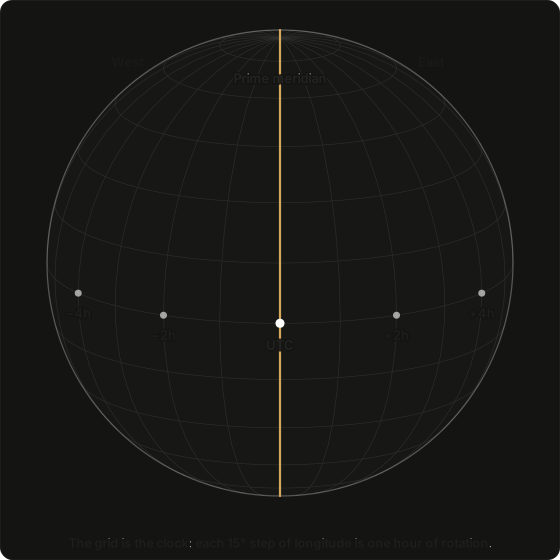
The grid on that globe is already drawn at 15° steps, which means the grid is the hour scale. Move one line east and local solar time is an hour later.
Taken literally this gives every town its own clock, which is what happened until the railways made it impractical. Two towns twenty miles apart have different local noons, by about a minute, and before timetables nobody minded.
Zones, and how ragged they are
The solution was to divide the world into 24 bands of 15°, with everyone in a band keeping the same clock. In practice the arrangement is much less regular:
- Boundaries are political, not geometric. They follow national and regional borders, detour around cities, and have been redrawn many times. China spans five geometric zones and uses one.
- Not all offsets are whole hours. India is UTC+5:30, Nepal UTC+5:45, the Chatham Islands UTC+12:45.
- Offsets change. Countries have shifted zone, adopted and abandoned daylight saving, and occasionally skipped a day entirely by moving across the date line.
This is the reason a zone cannot simply be computed from a longitude. Which zone a place keeps was settled by where somebody drew a boundary, not by any arithmetic on its coordinates — and which offset that zone was using is a further fact about the date.
So naming an instant takes two lookups rather than a calculation: the position picks out a zone, and the zone together with the date picks out an offset.
UTC
Underneath the zones sits one reference: Coordinated Universal Time.
UTC is not a time zone. It is the standard that every zone is expressed as an offset from — UTC+9, UTC−5, and so on — and the scale astronomical calculation actually runs on. Converting a civil time to UTC is the necessary first step for any chart, and it is the first thing done with any date and time you supply.
UTC and GMT are used interchangeably in ordinary speech and are not quite the same thing. GMT is mean solar time on the Greenwich meridian. UTC is kept by atomic clocks and nudged with occasional leap seconds to stay within a second of the Earth's actual rotation, because the Earth's rotation is slightly irregular and slowly slowing. For anything short of high-precision work the difference does not matter; for knowing which one a source means, it sometimes does.
Daylight saving is where charts break
A recorded birth time is civil time as the clock in that room read it. If daylight saving was in force, that clock was an hour off the zone's standard offset — and the certificate does not say so.
Recovering the true instant therefore requires knowing whether daylight saving was active at that place on that date, and that is hard to establish:
- Rules vary by country, and often by region within a country.
- Rules have changed repeatedly, sometimes at a few weeks' notice.
- Wartime measures introduced permanent or double summer time in several countries.
- Some places adopted it, dropped it, and adopted it again.
There is no formula for it, only a historical database, and the quality of a chart for a mid-twentieth-century birth depends directly on the quality of that database. Identifying the zone rather than the offset is what lets software consult that history rather than guess at it.
The error this causes is large. An hour of time is 15° of sky, and the Ascendant covers that much on average, which is half a sign. Because the ecliptic meets the horizon at a changing angle the real figure swings either side of it, and a fast-rising sign will carry the Ascendant more than a whole sign in the hour. The Midheaven shifts too, and every house cusp with it. The planets barely move, so the chart still looks plausible; it is simply wrong in the parts most sensitive to time.
What comes next
Daylight saving moves the clocks by an hour twice a year. In spring that hour is skipped, and no clock ever reads it. In autumn it is repeated, so a local time inside the repeat happens twice. No database can say which of the two a record means, and the next page explains why.