The Sky as a Sphere
Look up on a clear night and the sky does not look like a sphere. It looks like a dome — a ceiling, with points of light stuck to it, all seemingly the same distance away.
That impression is wrong about the universe but right about what you can measure, and astronomy builds a model on it.
The model
The celestial sphere is an imaginary sphere of unlimited radius, centred on the observer, onto whose surface every object in the sky is projected.
Every star and planet, and the Sun and the Moon, are treated as sitting on that surface itself, rather than near it or at various depths behind it.
The sphere has no radius worth quoting. Calling it "unlimited" is a way of saying the radius never enters any calculation, because the model never uses it.
What the model keeps, and what it throws away
The celestial sphere keeps direction and discards distance. That is the whole of the trade, and it does cost something, so it is worth looking at what is given up.
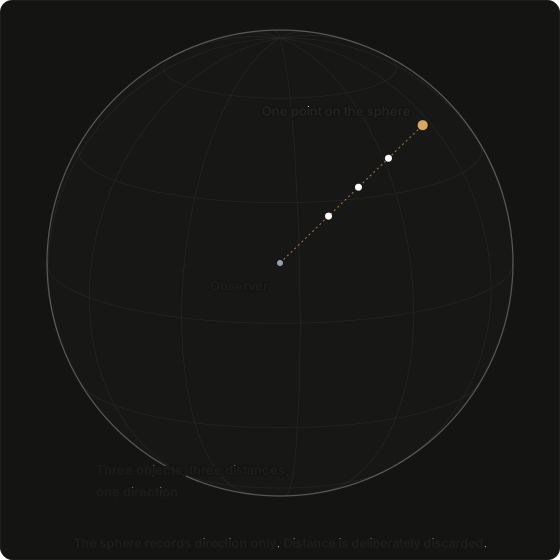
Three objects sit at three different distances. They lie in the same direction, so the sphere records them at a single point, and the model has nothing to say about which is nearer.
This sounds like a serious loss, but in practice it costs very little, for two reasons:
- Distance is not what you were asking. "What was overhead at that moment?" is a question about direction, and distance would add nothing to the answer.
- For the stars, the loss is not even measurable by eye. The stars are so far away that moving right across the Earth's orbit shifts their apparent positions by no more than a second or two of arc, even for the nearest of them. To an observer on the ground, they behave exactly as though they were painted on a sphere.
It is a surface, not an object
The most common misreading is treating the celestial sphere as a thing that exists — a shell somewhere out past the planets.
It is a coordinate surface. It exists in the same sense that lines of longitude exist: as an agreed framework for naming positions, not as material you could ever collide with. The sphere is scaffolding for describing directions, and the scaffolding is centred on whoever is doing the describing.
That is why the model belongs in the Locations category: the celestial sphere is yours, and it is centred on you. Changing the location does not adjust something on the sphere; it moves the sphere's centre.
Why the sphere appears to turn
Watch for an hour and the whole sphere appears to rotate, carrying every star with it, as one rigid piece.
In fact it is the Earth that turns, and the turning sphere is what that looks like from a platform you cannot feel moving. The model describes the appearance faithfully and says nothing about the cause.
That is deliberate rather than primitive. A chart is a record of a sky as seen from one place at one moment, so a model built around the observer is the one that fits. Knowing the Earth goes round the Sun does not make the observer-centred description wrong, any more than knowing about tectonic plates makes a street map wrong.
Where the approximation does break
The model's assumption that distance does not matter holds very well for the stars and acceptably for the planets, but it strains for the Moon.
The Moon is close enough that observers in different places see it in slightly different directions — by up to about a degree, roughly two of the Moon's own widths. That effect is called parallax, and it is the reason there is a choice of coordinate origin to make at all. Until that category, the sphere can be taken at face value.
What comes next
A sphere with nothing marked on it is not yet useful. The next page settles one distinction before anything is drawn on it, because the circles that follow are not all the same kind of circle.