How Latitude Tilts the Sky
Your local frame came from your position. The sky's frame came from the Earth's rotation. This page is about how the two sit relative to one another, and the answer is a single rule that the rest of the site uses often.
The pole's altitude is your latitude
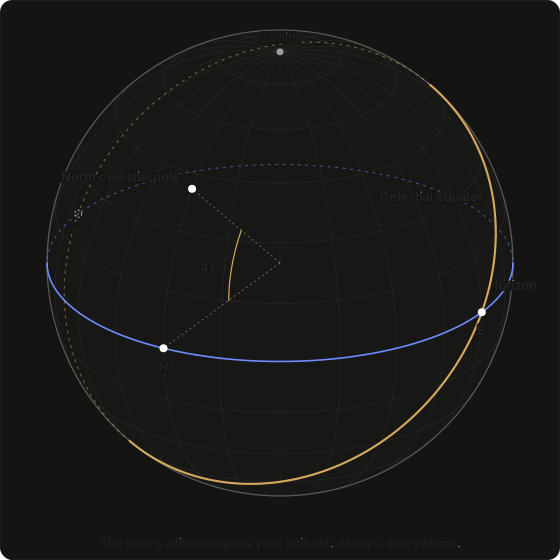
The altitude of the celestial pole equals your latitude.
The observer here is at latitude 41° north, and the north celestial pole stands due north, 41° above the horizon. The equality is exact, and it holds for every observer.
It is worth checking the extremes, because they make the rule obvious rather than arbitrary:
| Where you stand | Latitude | Pole appears |
|---|---|---|
| North pole | 90° N | At the zenith, directly overhead |
| New York City | 41° N | 41° above the northern horizon |
| Equator | 0° | On the horizon, due north |
| Sydney | 34° S | South celestial pole, 34° above the southern horizon |
Walk north and the pole climbs; walk south and it sinks, degree for degree. This is not a separate fact to memorise. It is the same statement as "your zenith is the direction from the Earth's centre through you", seen from a different angle.
It is also useful in practice. Measure the pole's height above the horizon and you have measured your latitude. Sailors navigated on exactly this for centuries.
What "tilt" means here
Because the whole sky turns about the polar axis, fixing where that axis points fixes how the sky's daily motion is angled against your ground.
At the equator the pole sits on the horizon. The axis lies flat, so bodies rise straight up out of the eastern horizon, climb vertically, and drop vertically into the west. Everything rises and everything sets, and everything spends twelve hours above the ground.
At the north pole the axis is vertical. Nothing rises and nothing sets at all; the sky simply turns, like a wheel seen face-on, and every body circles the sky at a constant height forever.
Everywhere in between you get a proportion of each. At 41° north the axis is tilted 41° from the horizon, so bodies rise at a slant, cut across the sky at an angle, and set at the matching slant on the other side.
That slant is why the length of a day varies with latitude, why the Sun's height at noon depends on where you are, and why the Ascendant moves at very different speeds at different latitudes, which matters a great deal for charts.
The one number that fixes the shape of your sky
The category so far comes down to three statements:
- Your latitude fixes how the sky is tilted, which fixes what rises, what sets, how steeply, and for how long.
- Your longitude fixes what time it is where you stand, which fixes which part of that sky is overhead at any given clock reading.
- Your height fixes almost nothing.
Changing the location from New York to Sydney does not adjust a preference; it gives the chart a different sky.
What comes next
One consequence of the tilt takes a page of its own: at any latitude off the equator, part of the sky never sets, and an equal part never rises at all.