The Horizon
Stand outside on open ground and look around. However much sky you can see, you are seeing about half of it. The rest is beneath your feet, behind the bulk of the Earth. The boundary between those two halves is the horizon, and it is the first circle in the sky worth naming.
Two different horizons
The horizon you can see is irregular. It rises where there are hills, drops where the land falls away, and is interrupted by trees and buildings. From a clifftop it sits noticeably lower than it does at sea level. This is the visible horizon, and no two observers share one.
Astronomy uses a cleaner idea. The true horizon — sometimes called the astronomical or celestial horizon — is the perfect circle you would see if the Earth were smooth, you were standing exactly on its surface, and nothing obstructed the view. It is defined geometrically rather than observed: take the plane that passes through you at right angles to straight up, extend it out in every direction, and the true horizon is the circle where that plane meets the sky.
Everything on this site means the true horizon. Where the distinction matters — a body rising a few minutes early because you are on a mountain, say — it is called out explicitly, and that particular case was worked through under Height Above Sea Level.
The horizon is a great circle
By the test from the previous page, the horizon is great: the plane defining it passes through the observer, who sits at the centre of their own sky. That is why it splits the sky into two equal halves.
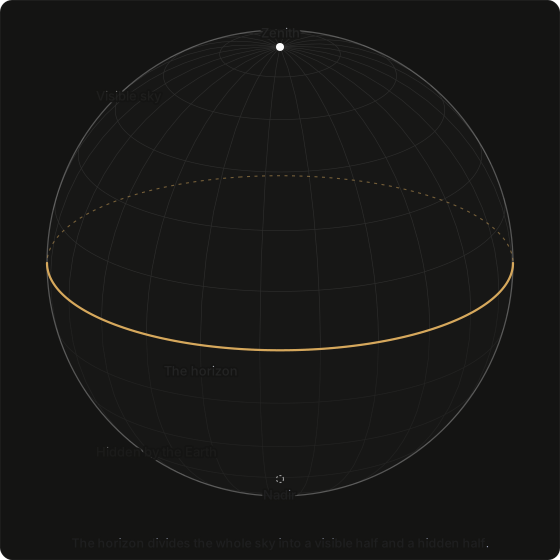
Picture yourself at the very centre of that sphere. The gold circle is your horizon, solid where it runs in front of you and dashed where it continues around behind. Everything in the brighter upper half is sky you could point at. Everything in the dimmer lower half is below your feet, with the Earth in the way. Two points are marked as well, one directly overhead and one directly underfoot: the zenith and the nadir, which are the next page's subject.
The horizon belongs to you
A horizon is not a feature of the sky. It is a feature of standing somewhere.
Two people far apart have different horizons. They are not the same circle seen from different angles, but different circles, tilted with respect to one another. A star sitting comfortably overhead for one may be below the ground for the other, at the same instant. Nothing about the star has changed; the observers simply disagree about which half of the sky is visible, because they disagree about which way is up.
This is the disagreement the category opened with, in Why a Chart Needs a Place — the star 55° up over Paris and 20° up over New York. The horizon is what those two observers did not share.
Crossing the line
Because the Earth turns, the sky appears to slide steadily past a fixed horizon. Most bodies cross that boundary twice a day:
- Rising — crossing the horizon on the way up, into the visible half.
- Setting — crossing it on the way down, into the hidden half.
The half of the sky you can see is always half, but it is never the same half for long. Over twenty-four hours a great deal of the sphere passes through your visible half — though not all of it. At any latitude off the equator, some sky in the direction of the nearer pole never sets, and a matching patch in the opposite direction never rises. The last page of this category, Sky That Never Sets, Sky That Never Rises, makes that precise.
Altitude
The horizon also gives the natural zero for measuring height in the sky.
Altitude is the angle from the horizon up to a body: 0° on the horizon, larger as it climbs, and negative below the horizon where a body has set.
This is the word reserved on the height page. On this site altitude is always an angle in the sky, never a height on the ground.
Where altitude tops out is the subject of the next page, because the horizon has a natural opposite.
Next: The Zenith and the Nadir.