The Zenith and the Nadir
The horizon gave you a boundary, and with no extra work it also gives you a centre.
Your zenith is the point on the sky directly overhead. Your nadir is the point directly underfoot, on the far side of the Earth. Between them they fix the axis of your local sky, and almost every local measurement is made against one or the other.
"Directly overhead" needs to be precise
Everyday speech uses up loosely. Astronomy cannot, so the zenith gets an exact definition:
Take the line running from the centre of the Earth through where you are standing, and continue it outward into space. The point where it meets the sky is your zenith.
Continue that same line in the other direction — down through your feet, through the centre of the Earth, out the opposite side — and where it meets the sky is your nadir.
This is the same line that fixed your latitude and longitude in Latitude and Longitude. Your coordinates named a direction from the centre of the Earth, and the zenith is that direction followed all the way out to the sky. Coordinates on the ground and the point overhead are two descriptions of the same thing.
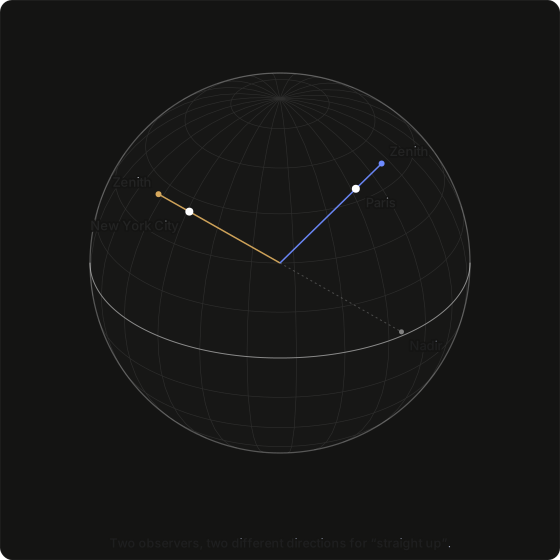
Both lines start at the same place — the centre of the Earth — and both are perfectly vertical for the person standing on them, yet they point in clearly different directions. There is no single "up" for the planet, only an up for each place on it.
The zenith and the horizon define each other
The zenith is not a separate fact added to the horizon; the two are tied together:
- The zenith sits at 90° from every point on the horizon.
- The horizon is exactly the set of points 90° away from the zenith.
Give someone your zenith and they can construct your horizon; give them your horizon and they can find your zenith. The relationship has a name: the zenith is the pole of the horizon circle — the pole every great circle has, as described in Great Circles and Small Circles.
That relationship supplies the scale for altitude: 0° at the horizon, 90° at the zenith. Nothing can have an altitude greater than 90°, because there is nowhere higher to be than straight up.
What this rules out
Once the zenith is defined precisely, a common assumption turns out to be wrong: that the Sun is overhead at noon.
For most of the world it never is. The Sun can only reach someone's zenith if that person is in the tropics — between about 23.4° north and 23.4° south. In New York or Paris the midday Sun climbs partway and stops, high in the south but never straight up, on every day of the year. At noon it is at its highest, which is not the same as being at the zenith.
Why the limit falls at 23.4° comes out of the tilt between two great circles, and it is the subject of The Obliquity of the Ecliptic in the last category on this site. The number will keep appearing until then.
Your zenith is moving
One more thing follows from the definition. Your zenith is fixed relative to the ground you are standing on, but the Earth is turning, so your zenith is constantly sweeping across the stars.
Sit still for six hours and you have not moved relative to your city, yet the piece of sky directly above you has been replaced entirely. The zenith is anchored to the Earth, not to the sky.
That is worth holding on to, because it is the reason a chart needs a time as precisely as it needs a place. The location fixes where the axis of your sky points; the clock fixes what the sky had rotated to when you looked.
What comes next
With a horizon and a zenith you have a frame, but not yet any way to say which direction along the horizon something lies. That needs marks on the circle.