Great Circles and Small Circles
Almost every page from here on draws a circle on a sphere. Those circles are not all the same kind of thing, and the difference decides what each one is good for.
The distinction
- A great circle is a circle on a sphere whose plane passes through the sphere's centre. It is the largest circle the sphere can carry, and it always divides the sphere into two equal halves.
- A small circle is any other circle on the sphere — one whose plane misses the centre. Small circles are always shorter, and they cut the sphere into two unequal pieces.
You have already met both, on the Earth. The equator is a great circle. A meridian of longitude is only half a circle, but continue it around the far side of the globe, through both poles, and the full circle it completes is a great circle too. Every parallel of latitude except the equator is a small circle, which is why parallels shrink towards the poles.
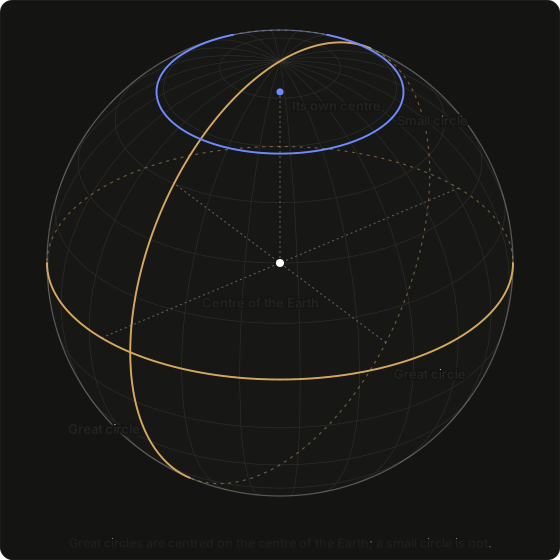
The dotted lines are the test. A diameter across either gold circle passes through the centre of the Earth, while the blue parallel rings a centre of its own, partway up the axis — its plane misses the Earth's centre entirely.
Why only great circles get to be reference circles
Every circle this site uses as a reference — the horizon, the meridian, the celestial equator, the ecliptic — is a great circle. That is not a matter of style; it follows from what a reference circle has to do.
A great circle halves the sphere. A reference circle is supposed to divide the sky into two even parts and give you a zero to measure from. Something that cuts off a small cap at one end cannot do that job.
A great circle has a pole. Every great circle has exactly two points sitting 90° from every point on it — its poles. That relationship is what lets you measure away from the circle as well as along it, and it is how every coordinate pair on this site is built. The horizon has the zenith and nadir. The celestial equator has the celestial poles. The ecliptic has the ecliptic poles.
A great circle is the straight line of a sphere. The shortest path between two points on a sphere always runs along the great circle joining them. This is why long-haul flights seem to arc north on a flat map. They are taking the straightest route there is; it is the flattening of the sphere that makes the route look curved.
Where small circles turn up
Small circles are not second-class; they simply play a different role. They are what you get when you hold one coordinate fixed and let the other run:
| Small circle | What is held fixed |
|---|---|
| A parallel of latitude on Earth | latitude |
| A body's daily path across the sky | its distance from the celestial pole |
| A circle of equal altitude | height above the horizon |
That middle row is the one that matters most on this site. As the sky turns, every body traces a circle about the celestial pole — and unless it happens to sit exactly on the celestial equator, that circle is a small circle. It is why some bodies are above the horizon for far longer than others, and why some never set at all.
A test you can apply
When a circle appears on a later page and you want to know which kind it is, ask one question: does its plane pass through the centre of the sphere?
If it does, it is great: it halves the sphere, it has poles, and it can serve as a reference. If it does not, it is small: it is a track something moves along, or a contour of constant something.
What comes next
The first circle to draw on your sphere is the one that divides the sky you can see from the sky you cannot. By the test just described it is a great circle, because its plane passes through you.
Next: The Horizon.