Equatorial Coordinates
Equatorial is the second setting. It measures along and away from the celestial equator.
Two angles
- Right ascension is the angle eastward along the celestial equator, starting from the vernal equinox and running all the way round.
- Declination is the angle north or south of the celestial equator, from 0° at the equator to ±90° at the poles. North is positive, south negative.
Both are angles, and both are commonly reported in degrees. Right ascension is also commonly written in hours, which is the subject of the next page.
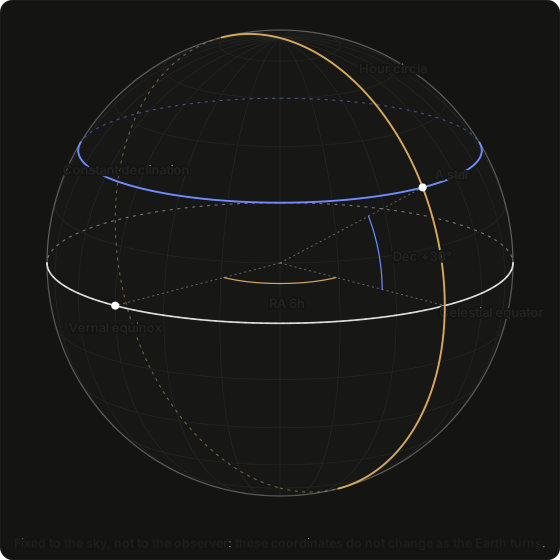
The construction is the same machine as the previous page, one plane over:
| Ecliptic frame | Equatorial frame |
|---|---|
| The ecliptic | the celestial equator |
| The ecliptic poles | the celestial poles |
| Celestial longitude | right ascension |
| Celestial latitude | declination |
| Vernal equinox as zero | vernal equinox as zero |
Declination is latitude, projected
Declination is the direct sky-equivalent of terrestrial latitude, and the resemblance is not loose. Because the celestial equator is the Earth's equator projected outward, a body with declination 41° passes directly overhead for an observer at latitude 41° north, and the two numbers match for that reason.
That single correspondence does a great deal of work:
- Your zenith has declination equal to your latitude.
- A body is circumpolar for you when its declination exceeds 90° minus your latitude — which is the rule Sky That Never Sets stated without being able to name it.
- How high a body climbs, and how long it stays up, follow from its declination and your latitude together.
What this frame is good at
It matches the sky's motion. The sphere turns about the celestial poles, so a body's declination does not change as the night passes and its right ascension tells you when it will cross your meridian. Two stars 45° apart in right ascension cross three hours apart, tonight and every night.
It survives being written down. Right ascension and declination do not change as the Earth turns and do not change if you travel. Two observers on opposite sides of the planet agree on them exactly. Every star atlas, every ephemeris and every telescope pointing model is built on this frame for that reason.
It is where declination-based relationships live. Parallels and contraparallels — bodies at matching distances from the equator — cannot be seen in the ecliptic frame at all. That is a later page in this category.
Coordinates need a date
"Fixed to the celestial sphere" is very nearly true, and the gap has a practical consequence.
The vernal equinox drifts, and the celestial equator swings with the pole, so the frame itself moves. A position is therefore quoted against an epoch — the date at which the equator and equinox being used were valid. J2000.0, the frame as it stood at the start of 2000, is the modern standard; positions of date use the frame as it is at the moment in question.
The two are not interchangeable. A J2000 position read as though it were of-date is off by a fraction of a degree today, and by more the further from 2000 the work strays. The frame moves because of precession.
What changes in the output
Under the Equatorial plane the headings follow the frame: what was reported as longitude is reported as right ascension, and what was latitude becomes declination — the same two coordinates, relabelled to say what they now contain.
One further change is larger than a relabelling, and a later page in this category is given over to it: the signs switch off. Under this plane right ascension is a plain angle, and no zodiac sign is attached to it.
What comes next
Right ascension is an angle, but outside astrology it is usually written in hours rather than degrees. The next page explains why, and how the two convert.