Right Ascension: Hours or Degrees
Right ascension is one angle measured around one circle. It is written two different ways, and the difference is a unit, not a quantity.
Astrological software uses degrees
Where a chart program reports right ascension at all, it is usually in decimal degrees, from 0° to 360° — the same scale and the same range as celestial longitude:
213.9125°
This is deliberate: keeping right ascension on the same scale as longitude means the two frames' first coordinates can be read against one another, and means every angular calculation — orbs, aspects, separations — works in one unit throughout. Nothing has to be converted on the way in or out.
Catalogues use hours
Almost everywhere else in astronomy, right ascension is quoted in hours, minutes and seconds, from 0h to 24h:
14h 15m 39s
The convention exists because the celestial sphere turns once a day, so an hour of right ascension is very nearly the amount the sky turns in an hour. That makes a difference in right ascension directly a difference in time: two stars 3h apart cross your meridian three hours apart, without any arithmetic in between.
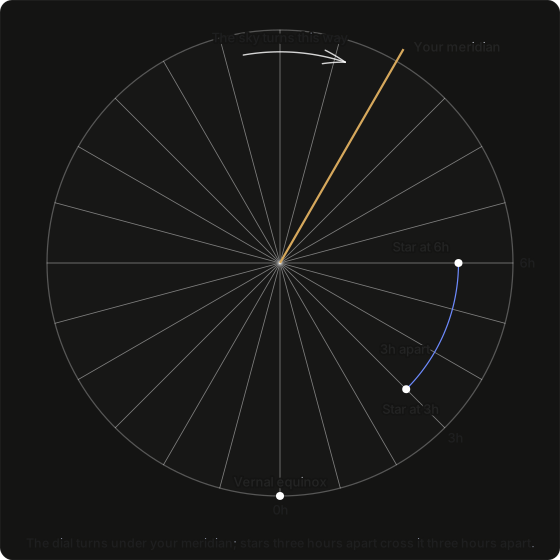
Seen square-on to the celestial pole, the arrangement is a dial. Each spoke is an hour circle, one per hour of right ascension, with the vernal equinox at 0h; your meridian is the fixed pointer, and the daily rotation turns the dial beneath it. The two marked stars sit three hours apart, so the second reaches the pointer three hours after the first — on every turn, without exception.
For an observer planning a night, that is the more useful unit; for a program computing angles, it is not.
Converting between them
The conversion is exact and easy. A full turn is 24 hours and 360 degrees, so:
15° = 1 hour
| Hours | Degrees |
|---|---|
| 1h | 15° |
| 1m | 0.25° |
| 6h | 90° |
| 12h | 180° |
| 24h | 360° |
To convert a catalogue value into degrees, multiply the hours by 15 and
add the minutes and seconds at the same rate. 14h 15m 39s is
14 × 15 = 210°, plus 15 minutes and 39 seconds of time at a quarter-degree per
minute — about 3.9° — giving roughly 213.9°, the figure at the top of this
page.
Which to expect where
| Source | Unit |
|---|---|
| Star catalogues and atlases | hours, minutes, seconds |
| Most observational software | hours |
| Most astrological software | degrees, 0–360, decimal |
If a right ascension looks fifteen times too small, it is in hours. If it looks fifteen times too large, it is in degrees. There is no ambiguity in practice, because the two ranges barely overlap — but a value between 0 and 24 falls in the one region where they do, and on its own it is ambiguous.
Declination has no such split
Declination is quoted in degrees everywhere, with no competing convention. Only the along-the-circle coordinate acquired the hour scale, because only that one tracks the sky's rotation.
What comes next
Both frames are now fully described, in units that can be relied on. The rest of this category is about what happens when a position is moved between them. The next page shows why the same body reads differently in the two frames, using a fence as the picture.