Precession Moves the Starting Point
Set a spinning top leaning over and it does not simply fall. Its axis traces a slow cone while the top keeps spinning fast.
The Earth does the same thing, over about 26,000 years.
The pole travels a circle
The Earth's axis keeps its 23.4° tilt, but the direction it leans in drifts. So the celestial pole — the point the whole sky appears to turn about — is not fixed. It travels a circle around the ecliptic pole, staying 23.4° from it throughout.
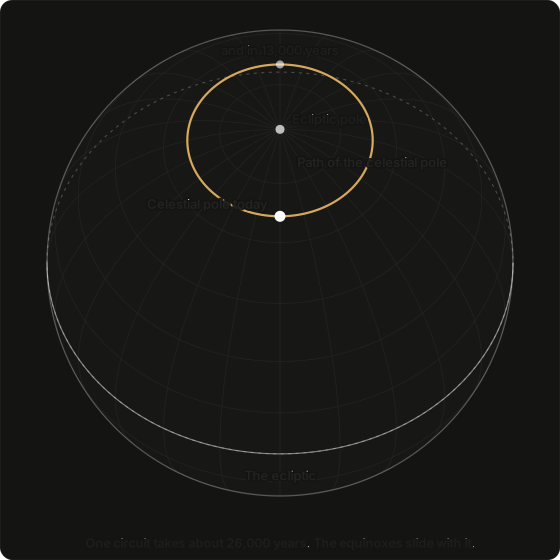
The ecliptic pole is the stable one, because it is defined by the Earth's orbit rather than its spin. The celestial pole circles it, and everything anchored to the celestial pole comes along.
The rate is about 50 arcseconds a year: one degree every 72 years. That is slow enough to be invisible in a lifetime, but fast enough that Greek astronomers detected it by comparing their measurements with records a couple of centuries older — Hipparchus, around 130 BCE, is generally credited with the discovery.
That date matters again in The Same Names on Two Zodiacs, where it helps explain how two zodiacs came to share one set of names.
Why it happens
The Earth is not a sphere: it bulges at the equator, by about 21 kilometres.
That bulge is tilted relative to the plane of the ecliptic, and the Sun and Moon pull on it, trying to tug it into line. A spinning body responds to such a pull not by tipping over but by swinging its axis sideways — which is why a leaning top circles instead of falling.
The Moon does most of the work, the Sun the rest. The planets add a much smaller contribution.
Pole stars are temporary
The most visible consequence is that the star nearest the celestial pole changes.
| When | Pole star |
|---|---|
| About 5,000 years ago | Thuban, in Draco |
| Now | Polaris, in Ursa Minor |
| About 12,000 years from now | Vega, in Lyra |
Polaris is unusually close to the pole — under a degree — and unusually bright, which is a coincidence of our era rather than a permanent feature. For most of history there has been no convenient pole star at all.
The equinoxes slide
The consequence that gives precession its name follows from the first figure in a single step.
The celestial equator is always 90° from the celestial pole. So as the pole circles, the equator swings with it. And the equinoxes are where that equator crosses the ecliptic — so as the equator swings, the crossings slide.
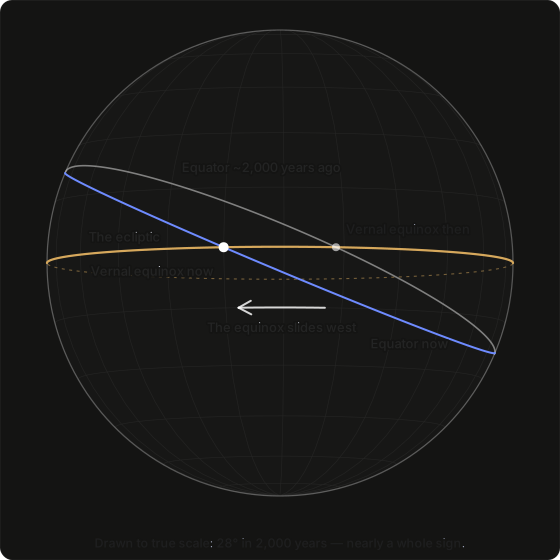
The gold ecliptic holds still while the celestial equator swings: blue where it lies now, grey where it lay two thousand years ago. Each crossing marks that era's vernal equinox, and the crossing has moved. The figure is drawn to scale: the 28° between the two is what two thousand years add up to, at the same 50 arcseconds a year that moves the pole.
The slide runs westward along the ecliptic: one degree every 72 years, a full circuit in 26,000.
What this does to a zodiac
The previous pages left the zodiac needing a starting point and offered the vernal equinox as a good one. This page shows the price of using it.
An equinox-anchored zodiac is a ruler whose zero mark slides along the circle at a degree every seventy-two years. Everything measured on it slides too. A star that has not moved in ten thousand years acquires a new zodiacal position every year.
This is not a defect to be repaired but what the definition asks for, and for one purpose, staying aligned with the seasons, it is the behaviour wanted.
But it means the Babylonians' star-anchored divisions and an equinox-anchored set of divisions cannot both be the zodiac. They have separated, and they are still separating.
Nutation
Superimposed on precession is a smaller, faster wobble called nutation: a nodding of the axis with a period of about 18.6 years and an amplitude of a few tens of arcseconds — about 9″ in the tilt itself, and about 17″ in the position of the equinox.
Its cause is that the Moon's orbit is itself tilted and its orientation rotates on that 18.6-year cycle, so the Moon's pull on the equatorial bulge varies slightly. Precession is the smooth average; nutation is the ripple on top.
For most purposes it can be ignored. Precise ephemeris work cannot ignore it, which is why calculations distinguish the mean equinox of date, with precession only, from the true equinox of date, with nutation included.
What comes next
That leaves two possible anchors, the equinox and the stars, separating at a degree every seventy-two years. The next two pages take them one at a time, starting with the zodiac anchored to the equinox: the tropical zodiac.
Next: The Tropical Zodiac.