The Vernal Equinox
The zodiac needs a starting point, and the first candidate is a strong one.
The vernal equinox is the point where the ecliptic crosses the celestial equator with the Sun moving northward.
The two circles cross twice. This is the crossing the Sun reaches around 20 March, going from south of the equator to north. The other crossing, six months later, is the autumnal equinox.
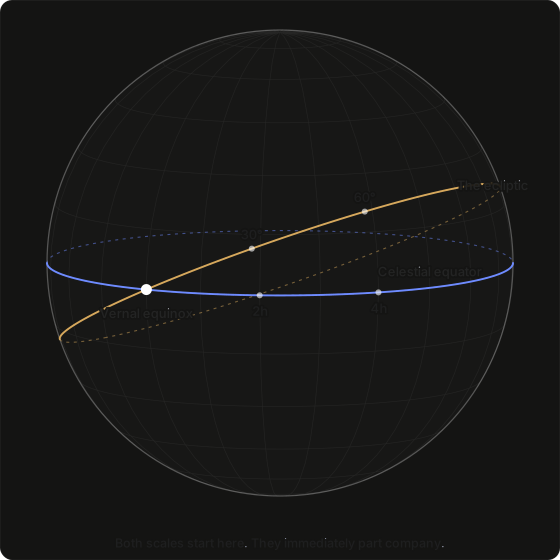
Two scales are shown leaving that single point, one running along each circle. They start together and immediately part company, because they run along different circles. That looks like a technicality here, but it is the subject of the last category on this site.
Why this point, and not some star
The choice can look arbitrary, but it is the least arbitrary zero available.
Longitude on Earth needed an arbitrary zero, and got one: an international conference picked Greenwich, and it could just as easily have picked Paris. There is nothing about that meridian that distinguishes it physically.
The vernal equinox needs no such agreement. It is defined entirely by the intersection of two physically meaningful planes — the plane of the Earth's equator and the plane of its orbit. Both exist whether or not anyone names them, and their crossing is a real feature of the geometry. Any astronomer anywhere would find the same point, without needing to be told where anyone else had put a marker.
That is the strongest possible basis for a coordinate zero: not agreement, but construction.
The First Point of Aries
The vernal equinox has an older name — the First Point of Aries — and the symbol ♈ is still used for it constantly.
The name is a fossil. When the convention was fixed, nearly two thousand years ago, the vernal equinox did sit at the start of the constellation Aries. It does not any more. It drifted out of Aries and through most of Pisces, and will reach Aquarius in about six more.
So the symbol ♈ marks a point that has not been in Aries since antiquity. The name is kept because changing it would invalidate every text and table ever written, which is a worse problem than a misleading label.
The name is misleading because the equinox moves, as the next section explains.
The equinox moves
The vernal equinox is defined by two planes, and neither of them holds still.
The Earth's axis wobbles like a slowing top, so the plane of the equator swings slowly. The plane of the orbit shifts slightly too. Their intersection therefore creeps — westward along the ecliptic by about 50 arcseconds per year, a full circuit in roughly 26,000 years.
This is awkward for a zero point. A scale measured from a drifting mark drifts with it, which means the position of a completely stationary star changes over time, purely because the ruler is sliding beneath it.
This is why a precise position carries an epoch: the date at which the equinox being used was valid. J2000.0 is the modern standard. A position without an epoch is incomplete.
The choice this forces
That leaves the question this category is about.
The vernal equinox makes a good zero in every respect but one: it moves against the stars. So anyone laying a zodiac on the ecliptic has to decide what to anchor it to.
- Anchor 0° to the equinox, and the zodiac stays locked to the seasons while drifting away from the stars.
- Anchor 0° to the stars, and the zodiac stays locked to the stellar background while drifting away from the seasons.
You cannot have both, because the two references are separating. The rest of this category follows from that separation, and Precession Moves the Starting Point explains the mechanism behind it.
Before that, the next page accounts for a much older decision: the one that produced twelve equal signs in the first place.
Next: Where the Signs Came From.