The Same Names on Two Zodiacs
Two zodiacs, two anchors, and the same twelve names. Aries, Taurus, Gemini, in the same order, running the same way round, in both systems.
That is peculiar enough to want explaining. Nobody sat down and decided to give two rival schemes an identical vocabulary, and the reason they share one is a coincidence of timing.
The Babylonians knew the equinox was not at zero
One fact rules out the obvious explanation.
The Babylonian zodiac was star-anchored. Their astronomers also tracked the equinox, and their texts record where it sat within their own divisions. Two schemes survive, and modern scholarship knows them as System A and System B:
| Scheme | Vernal equinox placed at |
|---|---|
| System A | 10° Aries |
| System B | 8° Aries |
So the equinox was not at the start of their Aries, and they knew it, and they wrote it down. Whatever else was going on, this was not a case of two anchors being confused because they happened to coincide.
At that date — the fifth century BCE and after — the two candidate zeros were about ten degrees apart.
Precession closed the gap
But the equinox was moving, westward along the ecliptic at a degree every seventy-two years, sliding towards the start of sidereal Aries.
Ten degrees at that rate takes about seven hundred years.
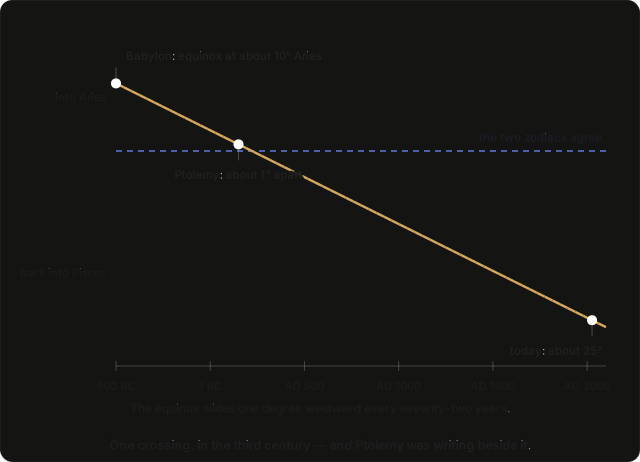
The crossing point — the moment a star-anchored zodiac and an equinox-anchored one gave the same answer for every body in the sky — falls in the third century AD. The two commonly used measures of the gap place it at 221 and 285; either way, the third century.
Before that date the equinox was inside sidereal Aries. After it, the equinox has been sliding back through Pisces, and the separation has grown to a little over twenty-five degrees.
The transfer, and whether it was deliberate
The Greek astronomical tradition inherited the Babylonian scheme — twelve equal divisions, thirty degrees each, those twelve names — and re-anchored it to the equinox. Ptolemy, writing around 150 AD, defines the signs from the equinoctial and solstitial points explicitly. That is the tropical definition, set down in the text that Western astronomy and astrology both descend from.
Look at where 150 AD falls on the figure. It is within about a degree of the crossing.
So the question of whether the switch was made knowingly has a two-part answer, and both parts are true:
Knowingly, in the sense that the mechanism was understood. Hipparchus had discovered precession around 130 BCE — nearly three centuries before Ptolemy, who discusses it at length. Nobody in that tradition thought the equinox was fixed against the stars.
Accidentally, in the sense that nothing forced a choice. At the moment the tropical definition was written down, the two anchors gave answers separated by roughly one degree — less than the width of the Sun's own disc twice over, and below the practical accuracy of the positions anyone was working with. Every calculation came out the same either way. There was no disagreement to notice, no error to correct, and no reason for anyone to record which anchor they had adopted, because for their lifetime it made no difference.
The names carried over intact while the anchor underneath them changed, and precession has continued ever since.
Why this matters for reading old sources
A position quoted in a source from the first few centuries AD is very nearly the same in both zodiacs, so it cannot tell you which one the author meant. The text will usually not say, because at the time there was nothing to say.
The ambiguity grows at a degree every seventy-two years, which means a seventh-century source is about six degrees ambiguous, and a modern one quoted without its zodiac is ambiguous by nearly a whole sign. The further from the third century a source sits, the more its zodiac matters and the more likely it is to have been stated.
What comes next
The gap between the two zeros has been described here as a piece of history. It is also a number, measured and updated continuously, and a specific value for it is needed before any sidereal position can be computed at all. The next page describes that number, the ayanamsa.
Next: The Ayanamsa.