Where the Signs Came From
Twelve equal divisions of 30° is not something the sky offers. It was a decision, made in Babylon a very long time ago, and it was a good one.
First, the constellations
Babylonian astronomers watched the Sun's slow annual creep and did the obvious thing: they named the star patterns it passed through.
That gave them a band of constellations circling the sky — a lion, a scorpion, a bull, a pair of scales — and a way of saying roughly where the Sun, Moon and planets were on any given night. The Moon is in the Bull. For describing the sky to another person, that works well.
For calculation it does not work, because the constellations are not the same size.
The constellations are ragged
Star patterns are shapes people noticed. Nothing made them regular, and they are not.
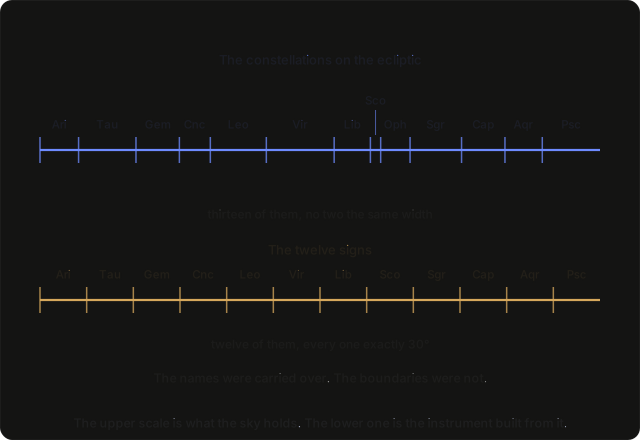
The upper scale is what the sky actually holds. The Sun crosses Scorpius in about a week and takes something over six weeks to cross Virgo. And the ecliptic passes through thirteen star patterns, not twelve: Ophiuchus, the serpent-bearer, sits between Scorpius and Sagittarius, and the Sun spends longer in it than in Scorpius.
Thirteen unequal divisions do not make a usable scale. You cannot add to it, subtract from it, or predict with it. Every question of the form where will Mars be in eighty days becomes a separate research problem.
Then, the decision
So the Babylonians replaced it.
By roughly the fifth century BCE their astronomical texts use a zodiac of twelve equal divisions, 30° each, laid along the Sun's path — the lower scale in the figure. The constellation names were carried over as labels for the new divisions, and the ragged boundaries they came from were discarded.
This was not a failure of observation. The Babylonians had measured those constellations well enough to know exactly how uneven they were; the whole point of the reform was that they knew. They traded a description of the sky for an instrument, because an instrument is what lets you compute.
Everything the zodiac has been able to do since — predict positions, add intervals, measure angles between bodies — comes from that trade.
What follows from it
The signs have never been the constellations. They were made different by design, from the beginning, and not through error or drift.
Twelve equal 30° divisions were imposed on thirteen unequal star patterns. The result is two systems of different sizes and different counts that share a set of names. They could not have matched at any point in history, and nobody involved imagined they did.
This answers the news story that appears from time to time announcing that everyone's star sign is wrong because there are really thirteen constellations. The story compares twelve equal divisions against thirteen unequal ones and reports, accurately, that they differ. They were built to differ, so the comparison shows nothing that was not known from the start.
What it does not dispose of
There is a second, separate reason the signs and the constellations do not line up today, and this page has not touched it.
The Babylonians pinned their divisions to the stars. Later astronomy pinned the same twelve divisions to the equinox instead — and, as the previous page established, the equinox does not hold still against the stars. So on top of the built-in mismatch there is now an accumulated slide, and it is larger than most people expect.
The next page explains that slide, which is called precession, and the rest of this category depends on it.