The Ecliptic
The stars hold their positions. Night after night, year after year, the patterns do not change, and the whole sphere simply turns.
The Sun is the exception. As well as turning daily with everything else, it creeps slowly against the background of stars — about one degree per day, eastward — until after a year it arrives back where it began.
The path it traces is the ecliptic, and it is the circle the zodiac is laid along.
A great circle, not a wandering line
The Sun's annual path does not wander. It follows a great circle on the celestial sphere: the same kind of circle as the horizon and the celestial equator, dividing the sphere into equal halves.
It is a circle because the Earth's orbit is a flat, closed loop. Seen from inside that orbit, the Sun appears to travel round the plane of the loop — and a plane through the observer cuts the sphere in a great circle. The ecliptic is the Earth's orbital plane, projected onto the sky.
The name comes from eclipses. They can only happen when the Moon is on or very near this circle, so it became "the line where eclipses occur" long before anyone described it as an orbital plane.
Where it crosses the equator
The ecliptic and the celestial equator are two great circles on the same sphere, tilted with respect to one another. Two such circles always cross at exactly two points, opposite each other.
The figure below has no horizon. Every figure in the Locations category was drawn around an observer; this one is fixed to the sky itself and tied to no one's local view, so a single figure serves every observer on Earth.
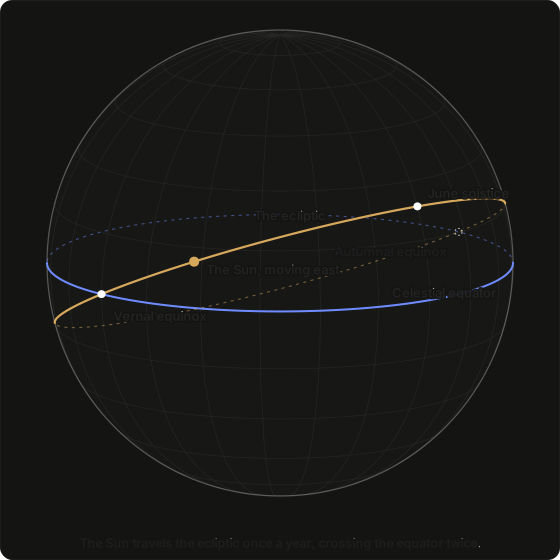
Those two crossings are the equinoxes:
- The vernal equinox is where the Sun crosses from south of the equator to north of it, around 20 March. Much of the rest of this category is measured from this point.
- The autumnal equinox is the opposite crossing, around 22 September, where the Sun passes from north to south.
Halfway between them the ecliptic reaches its greatest distance from the equator. Those are the solstices — around 21 June, when the Sun stands furthest north, and 21 December, when it stands furthest south.
These four are positions on the sphere, not dates. The dates are when the Sun happens to arrive at them. An equinox is a place first and a moment second, and keeping that order straight prevents a lot of confusion later.
Two motions at once
It is easy to lose track of which motion is which, because both are happening the whole time.
| Motion | Period | What moves |
|---|---|---|
| Diurnal | About 24 hours | The whole sphere turns about the celestial poles |
| Annual | About 365¼ days | The Sun creeps eastward along the ecliptic |
The daily turn is fast and obvious. The annual creep is slow — a degree a day, about two Sun-widths, far too gradual to notice in one night and impossible to miss over a season.
The ecliptic itself is effectively fixed on the celestial sphere. It is the Sun that travels along it. A useful mental image: the ecliptic is a painted lane on the sphere, turning with everything else once a day, and the Sun is walking slowly along that lane.
The band everything keeps to
The Sun is not the only body that keeps to the ecliptic's neighbourhood.
The planets orbit in roughly the same plane as the Earth, so from here they never stray far from the ecliptic — a few degrees either side, with Mercury and Pluto straying furthest. The Moon's orbit is tilted about 5° to it, which is why eclipses are occasional rather than monthly: most months the Moon passes above or below the Sun's position rather than across it.
That crowding is what makes the ecliptic worth singling out as the zodiac's circle. A band roughly 8° either side of it contains the Sun, the Moon and all the classical planets, all the time. Everything a chart plots lives in that narrow strip.
That "few degrees either side" is easy to skim past. It is worth holding on to, because bodies are near the ecliptic, not on it, and that small distance has consequences large enough to move a transit by years. Those consequences are the business of the Reference Planes category.
What comes next
With the circle defined, the twelve equal divisions need a starting point. The next page takes the first candidate: the vernal equinox, the crossing where the Sun moves north.
Next: The Vernal Equinox.