Solar Eclipse Hotspots Study
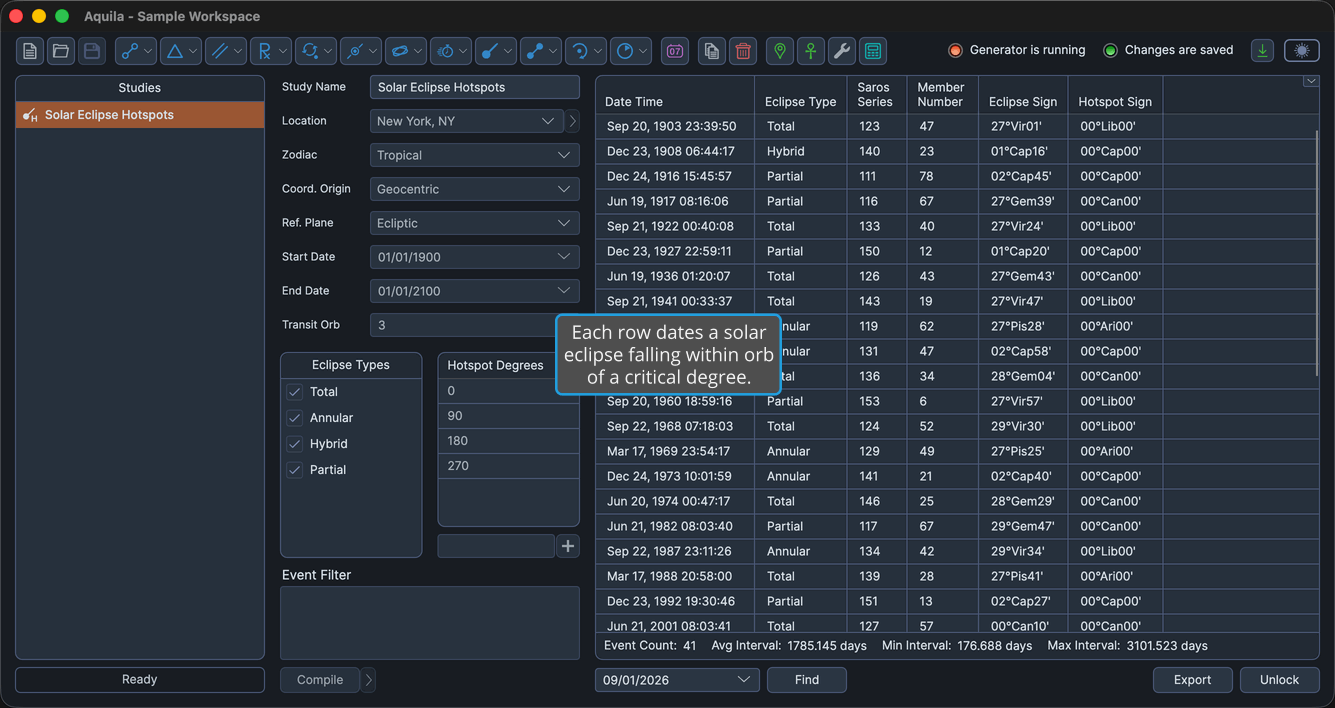
An eclipse landing on a sensitive degree is the case practitioners care most about, and picking those out of a general eclipse list by eye is slow work. The Solar Eclipse Hotspots study isolates them for you.
The study generates an event each time a solar eclipse falls within orb of one of the critical degrees you are watching, recording both the eclipse and the degree it contacted.
Create a Solar Eclipse Hotspots Study
To add a Solar Eclipse Hotspots study to the current workspace:
- Click Mundane Studies → Eclipses on the menu bar.
- Click Solar Eclipse Hotspots in the Eclipses submenu.
Alternatively, click the Solar Eclipse Studies drop-down button on the toolbar and select Solar Eclipse Hotspots from its flyout.
The new study appears at the bottom of the Studies list and is selected automatically, so its settings open immediately. It takes its name from the study type.
What This Study Finds
A hotspot is a critical degree on the zodiac that you have named yourself, and this study lists only the solar eclipses that fall close enough to one of them to count as a contact. How close is close enough is set by the Transit Orb field, in degrees.
Its settings carry three things the technique needs: a Transit Orb field, an Eclipse Types list restricting the study to total, annular, hybrid or partial eclipses, and a Hotspot Degrees table holding the degrees being watched. As with the plain eclipse studies, there are no body selection lists, since the bodies involved in an eclipse are fixed.
Events Table Columns
The events table lists one row per contact. Several columns are hidden by default, as the table notes. Right-click any column header to show or hide a column, as described in Choose Events Table Columns. The header text of the coordinate columns follows the study's Reference Plane: they read Longitude and Latitude in the ecliptic plane and Right Asc and Declination in the equatorial plane. The table below uses the ecliptic-plane headers.
| Column | Description |
|---|---|
| Date Time | Date and time the event perfects, in the application's long date-time format. Always the first column, and it cannot be moved. Visible by default. |
| Eclipse Type | The kind of eclipse the event records. Visible by default. |
| Saros Series | The eclipse's Saros series, as a whole number. Visible by default. |
| Member Number | The eclipse's member number within that series, as a whole number. Visible by default. |
| Eclipse Longitude | The eclipse's primary coordinate in degrees. Hidden by default. |
| Eclipse Sign | The eclipse's position as degrees, sign and minutes of the zodiac. Visible by default. |
| Eclipse Latitude | The eclipse's secondary coordinate in degrees. Hidden by default. |
| Hotspot Longitude | The contacted critical degree's primary coordinate, in degrees. Hidden by default. |
| Hotspot Sign | The contacted critical degree as degrees, sign and minutes of the zodiac. Visible by default. |
| Event Interval | Elapsed time since the previous event in the list. Hidden by default. |