Solar Limit Transits Study
Crossing the solar limit is the moment a body goes out of bounds, passing beyond the greatest declination the Sun itself ever reaches. The Solar Limit Transits study dates those crossings for the bodies you follow.
The study generates an event each time a selected body's declination crosses one of the Sun's declination limits. Those limits are set by the obliquity of the ecliptic and are recomputed as it changes, so they sit at roughly plus or minus 23.44 degrees at present rather than at a fixed value.
Create a Solar Limit Transits Study
To add a Solar Limit Transits study to the current workspace:
- Click Mundane Studies → Declination Studies on the menu bar.
- Click Solar Limit Transits in the Declination Studies submenu.
Alternatively, click the Declination Studies drop-down button on the toolbar and select Solar Limit Transits from its flyout.
The new study appears at the bottom of the Studies list and is selected automatically, so its settings open immediately. It takes its name from the study type.
What This Study Finds
The Sun's declination runs between about 23.44 degrees north and about 23.44 degrees south over the course of a year, and those two figures are the solar limits. A body whose own declination passes one of them has moved outside the band the Sun keeps to, and the study records the instant of every such crossing for the bodies you check.
Its settings are laid out inline rather than on tabs: the Ephemeris rows, the date range, an Event Type drop-down and a single Bodies selection list. The Event Type drop-down restricts the study to northern limit transits alone or to southern limit transits alone, or leaves it generating both. Each limit yields two kinds of event, the crossing out beyond the limit and the return back inside it, which is why the events table's Event Type column reports four values. The Sun, the diurnal angles, the lunar axis points and the hypothetical Uranian bodies are not offered in the body list. See Which Bodies a Study Offers for the full set a study omits.
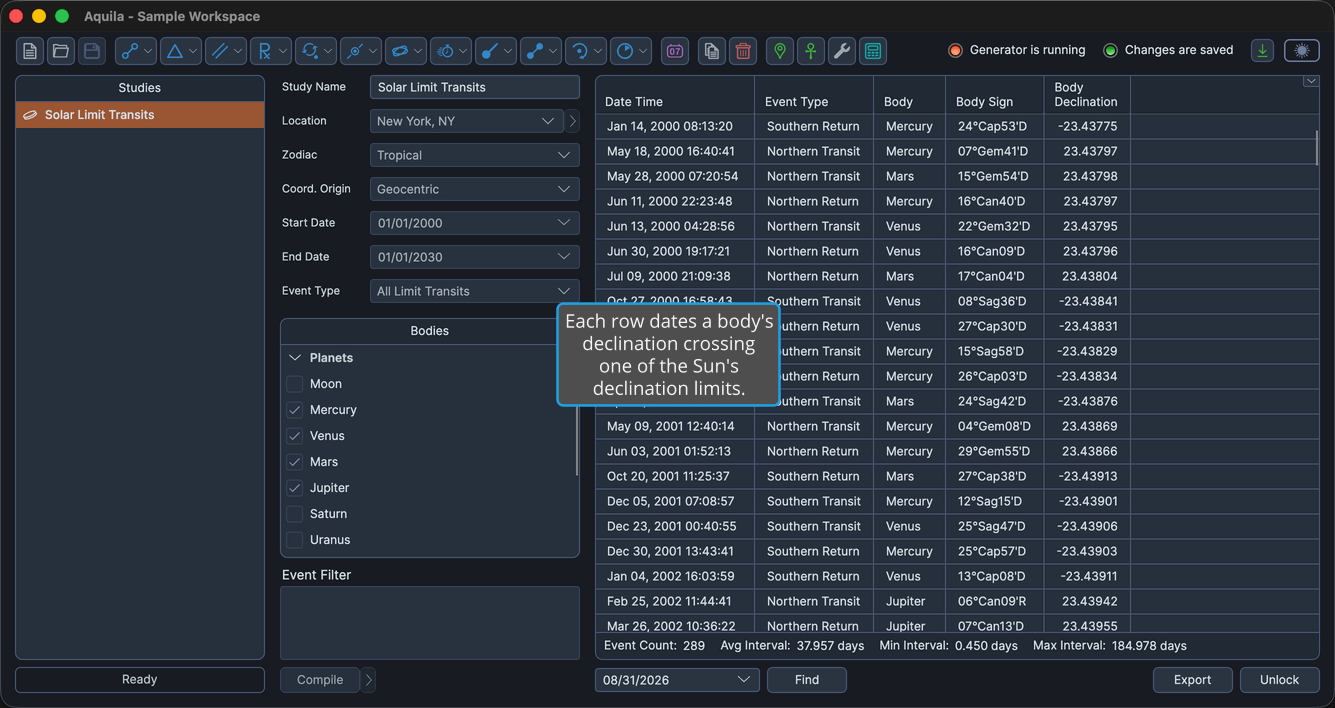
Events Table Columns
The events table lists one row per limit crossing. Several columns are hidden by default, as the table notes. Right-click any column header to show or hide a column, as described in Choose Events Table Columns. Unlike most studies, this one always works in the equatorial plane rather than offering the usual Longitude and Latitude alternative, so its coordinate columns are always headed Right Asc and Declination.
| Column | Description |
|---|---|
| Date Time | Date and time the event perfects, in the application's long date-time format. Always the first column, and it cannot be moved. Visible by default. |
| Event Type | Which crossing the event records: Northern Transit, Northern Return, Southern Transit or Southern Return. Visible by default. |
| Body | Name of the celestial body. Visible by default. |
| Body Right Asc | The body's primary coordinate in degrees. Hidden by default. |
| Body Sign | The body's position as degrees, sign and minutes of the zodiac. Visible by default. |
| Body Declination | The body's secondary coordinate in degrees. Visible by default. |
| Body Distance | The body's radial distance in astronomical units (AU). Hidden by default. |
| Body Speed | The body's speed in degrees per day. Hidden by default. |
| Event Interval | Elapsed time since the previous event in the list. Hidden by default. |