Appulse Minima Study
A conjunction measured in longitude alone can still be far apart in the sky, so users who care about genuine visual proximity want the true closest approach instead. The Appulse Minima study supplies it, generating an event each time two transiting bodies reach a local minimum of their true great-circle angular distance while within orb of each other.
Each event records both bodies, their positions at the moment of closest approach, and the angular distance that separated them.
Create an Appulse Minima Study
To add an Appulse Minima study to the current workspace:
- Click Mundane Studies → Aspects on the menu bar.
- Click Appulse Minima in the Aspects submenu.
Alternatively, click the Aspect Studies drop-down button on the toolbar and select Appulse Minima from its flyout.
The new study appears at the bottom of the Studies list and is selected automatically, so its settings open immediately. It takes its name from the study type.
What This Study Finds
An event is generated at the instant of closest approach in the sky: the moment two transiting bodies reach a local minimum of their true angular distance, combining both longitude and latitude rather than longitude alone. Only minima that fall within the Appulse Orb become events.
That combination is what separates this study from the Mundane Aspects study. Two bodies can share a longitude to the arcminute and still stand degrees apart on the sphere because one of them is far off the ecliptic; an appulse minimum measures the gap the observer sees.
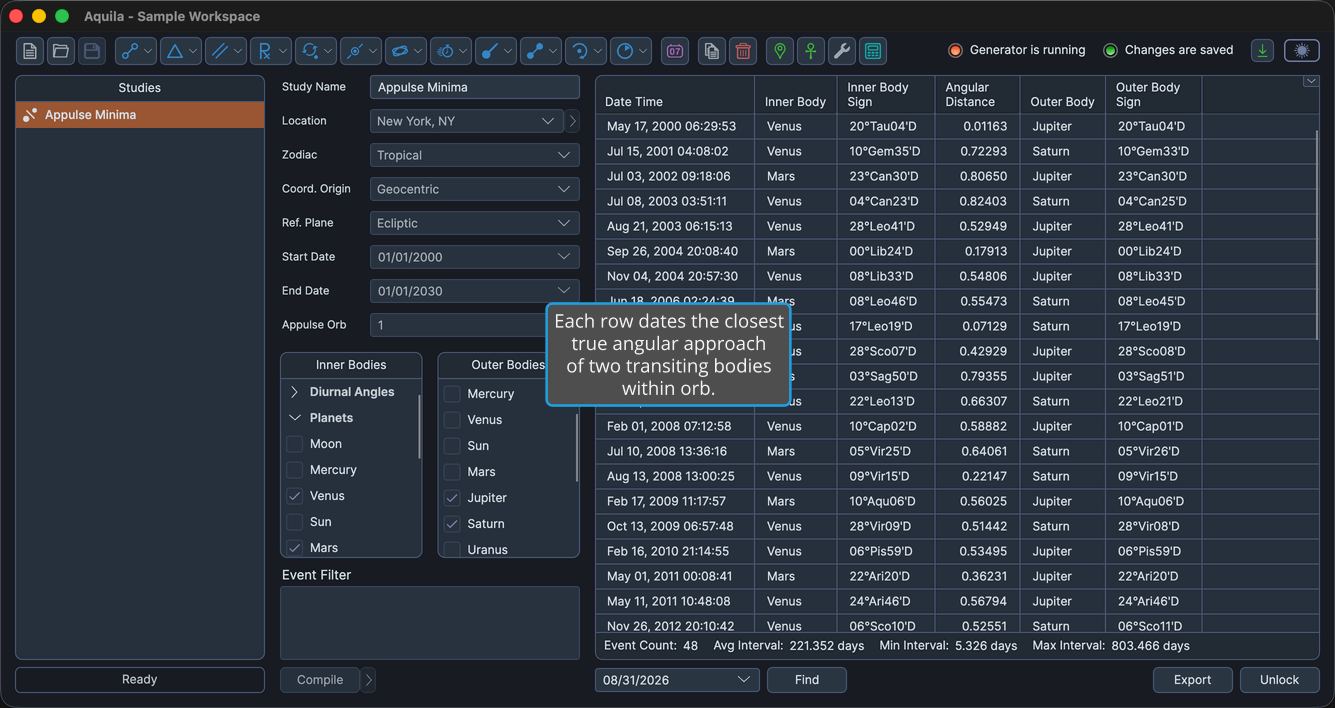
Because the technique works in latitude as well as longitude, the hypothetical Uranian bodies are not offered in this study's body lists. The settings carry the Study Name, the ephemeris settings and the study date range, the Appulse Orb field, and the Inner Bodies and Outer Bodies selection lists that supply the pairs to test.
Set the Appulse Orb
The Appulse Orb sets how close two bodies must come, in true great-circle angular distance, for their closest approach to be counted as an event. The field accepts a value from 0 to 90 degrees and starts at 1 degree.
To set the orb:
- Type the orb in degrees into the Appulse Orb field.
The field is available only while the study is unlocked.
Events Table Columns
The events table lists one row per minimum. Several columns are hidden by default, as the table notes. Right-click any column header to show or hide a column, as described in Choose Events Table Columns. The coordinate columns follow the study's Reference Plane: their headers read Longitude and Latitude in the ecliptic plane, and Right Asc and Declination in the equatorial plane. The table below gives the ecliptic-plane headers.
| Column | Description |
|---|---|
| Date Time | Date and time of the closest approach, in the application's long date and time format. Always the first column, and it cannot be moved. Visible by default. |
| Inner Body | Name of the inner body of the pair. Visible by default. |
| Inner Body Longitude | The inner body's primary coordinate, in degrees. Hidden by default. |
| Inner Body Sign | The inner body's position as degrees, sign and minutes of the zodiac. Visible by default. |
| Inner Body Latitude | The inner body's secondary coordinate, in degrees. Hidden by default. |
| Inner Body Distance | The inner body's radial distance, in astronomical units (AU). Hidden by default. |
| Inner Body Speed | The inner body's speed, in degrees per day. Hidden by default. |
| Angular Distance | The true great-circle angular distance between the two bodies at the minimum, in degrees. Visible by default. |
| Outer Body | Name of the outer body of the pair. Visible by default. |
| Outer Body Longitude | The outer body's primary coordinate, in degrees. Hidden by default. |
| Outer Body Sign | The outer body's position as degrees, sign and minutes of the zodiac. Visible by default. |
| Outer Body Latitude | The outer body's secondary coordinate, in degrees. Hidden by default. |
| Outer Body Distance | The outer body's radial distance, in astronomical units (AU). Hidden by default. |
| Outer Body Speed | The outer body's speed, in degrees per day. Hidden by default. |
| Event Interval | Elapsed time since the previous event in the list. Hidden by default. |