Primary Direction Settings
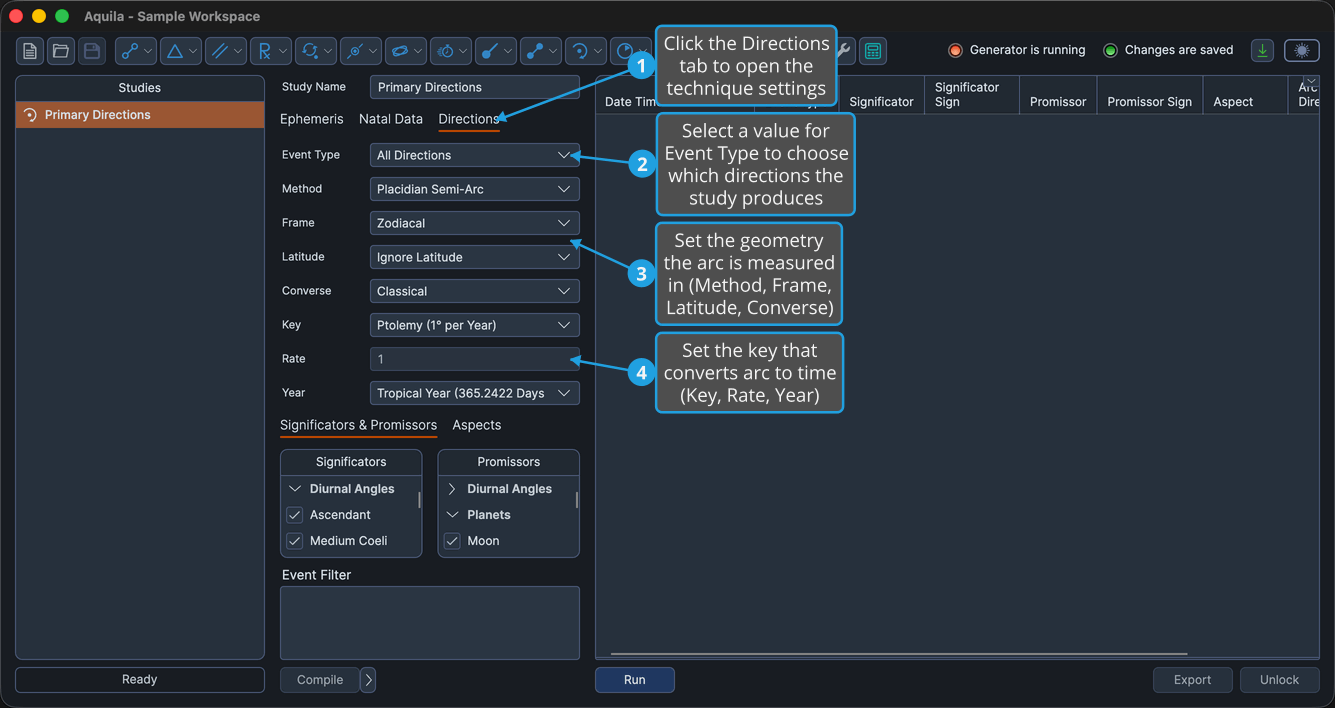
The Directions tab of the Primary Directions Study holds the technique options: Method, Frame, Latitude, Converse, Key and the Rate box that goes with a user-defined key. The tab also carries the shared Event Type and Year drop-downs.
Primary directions vary enormously between schools, and every one of these options changes which events appear and on what dates. Nothing here is a display preference, so it is worth setting all of them deliberately before generating events.
Configure the Primary Directions Technique
To state the conventions the study directs by:
- Click the Directions tab. The technique settings sit on their own tab of the study's settings column.
- Choose which directions the study produces: select a value for Event Type. This decides whether the study reports direct directions, converse directions, or both.
- State how the arc is measured. Select values for Method and Frame; the Latitude row then accepts a value while the Frame is Zodiacal, and the Converse row while the Event Type is not Direct Directions. Together these four conventions fix the geometry the arc of direction is worked out in.
- State the key that converts arc to time. Select a Key first; while it is User-Defined Rate, the Rate box accepts the degrees of arc per year of life. Then select a Year reckoning. Together these turn each direction's arc into the calendar date the study reports.
Technique Options
Each drop-down below sets one convention of the technique.
Method
The projection that defines what it means for a promissor to arrive at a significator's place, that is, which family of circles divides the sphere. Both methods measure in right ascension, and both give the same answer on the meridian and on the horizon, where the two families coincide.
| Option | What It Means |
|---|---|
| Placidian Semi-Arc | The proportional semi-arc method associated with Ptolemy and Placidus, and the default. A point's place is defined by the proportion of its own diurnal or nocturnal semi-arc that separates it from the meridian. A circumpolar point has no semi-arc, so a circumpolar point in either role means the direction is omitted. |
| Regiomontanus Position Circle | The rational, or circle of position, method. A point's place is defined by the great circle drawn through the point and the north and south points of the horizon. Every point off the horizon's north to south axis lies on exactly one such circle, so this method can direct circumpolar significators; it omits only a promissor whose declination cannot reach the aspected circle. |
Frame
Whether the meeting is defined between ecliptic longitudes or between the actual positions of the two bodies on the sphere.
| Option | What It Means |
|---|---|
| Zodiacal | The aspect is applied to the promissor's ecliptic longitude, producing an aspect ray at that longitude, and it is the ray that is directed to the significator's place. Latitude is then handled by the Latitude setting. The default, and the frame most commonly used in modern practice. |
| Mundane | The promissor itself is directed, at its actual position, and the aspect is applied in mundane degrees, degrees of the same division of the sphere that the chosen Method uses. Both points always keep their true latitude, so the Latitude setting is ignored and its drop-down is disabled. Also called directing in mundo, or with latitude. |
Latitude
Which of the two points keep their ecliptic latitude. The drop-down is enabled only when the Frame is Zodiacal, because mundane directions always use the true latitude of both points. Whichever mode you choose, the latitude attaches to every aspect ray, not only to the conjunction.
| Option | What It Means |
|---|---|
| Ignore Latitude | Both points are reduced to the ecliptic, with latitude treated as zero. The default, and the most common convention in modern practice. |
| Both Latitudes | Both the significator and the promissor's aspect ray keep the true ecliptic latitude of their body. |
| Significator Latitude Only | The significator keeps its true latitude; the promissor's aspect ray is reduced to the ecliptic. |
| Promissor Latitude Only | The promissor's aspect ray keeps the promissor's true latitude; the significator is reduced to the ecliptic. |
Converse
How a converse direction is defined. The two definitions are not variants of one arc, they produce genuinely different arcs, and both are in current use. The drop-down is enabled unless the Event Type is Direct Directions, since it has nothing to act on there.
| Option | What It Means |
|---|---|
| Classical | The roles of the two points are exchanged: the significator is carried by primary motion to the natal place of the promissor. The Significator and Promissor labels reported on the event are unchanged. The default. |
| Modern | Sometimes called neo-converse. The promissor is carried backward against primary motion, producing a negated arc. The event is still dated forward into life, at the natal instant plus the magnitude of the arc in years. |
Key
The rule that converts an arc of direction into elapsed years of life. Every key works out to roughly one degree per year, but the small differences accumulate: over a long life the same arc can fall a year or more apart under different keys, so the choice is an interpretive decision rather than a formatting preference.
| Option | What It Means |
|---|---|
| Ptolemy (1° per Year) | Exactly one degree of arc for each year of life. The default, and the simplest key. |
| Naibod (59'08" per Year) | 0°59'08" of arc per year, the Sun's mean daily motion. |
| Cardan (59'12" per Year) | 0°59'12" of arc per year. |
| Kepler — Natal Solar Rate in RA | The Sun's own motion in right ascension on the day of birth becomes the rate, so this key is specific to the natal record. |
| Natal Solar Rate in Longitude | The same idea measured in ecliptic longitude instead: the Sun's longitude motion on the birth day becomes the rate. |
| Placidus — True Solar Arc in RA | The true solar arc. Rather than applying a fixed rate, the study finds how many days after birth the Sun needs to advance in right ascension by the arc of direction, and that number of days becomes that number of years. The most demanding key; a combination whose iteration fails to converge is omitted and reported. |
| User-Defined Rate | A rate you supply yourself, in degrees per year, in the Rate box. |
Rate
The user-defined key rate, in degrees of arc per year of life. The box is enabled only when the Key is User-Defined Rate and the study is unlocked, and it accepts values from 0.01 to 10. The rate must be greater than zero, since a rate of zero would produce no dates and a negative rate would mirror them.
Event Type and Year
Two of the drop-downs on this tab are shared with other studies rather than belonging to the technique itself.
- Event Type chooses between all directions, direct directions only and converse directions only. See Event Type Selection for the full list of values.
- Year fixes how long a year of life is when the elapsed years the key produced are turned into a calendar date. It never changes a key: Naibod, Cardan, Kepler and Placidus describe the Sun's real motion and keep their astronomical values under either reckoning. See Year Reckoning.
Because a prophetic year is about 1.5% shorter than a tropical one, the same arc under the same key falls about 1.5% earlier in life under the prophetic reckoning. The Age at Event column reports ages in the study's own reckoning, so a prophetic study's ages are counts of 360-day years.