Solar Arc Direction Settings
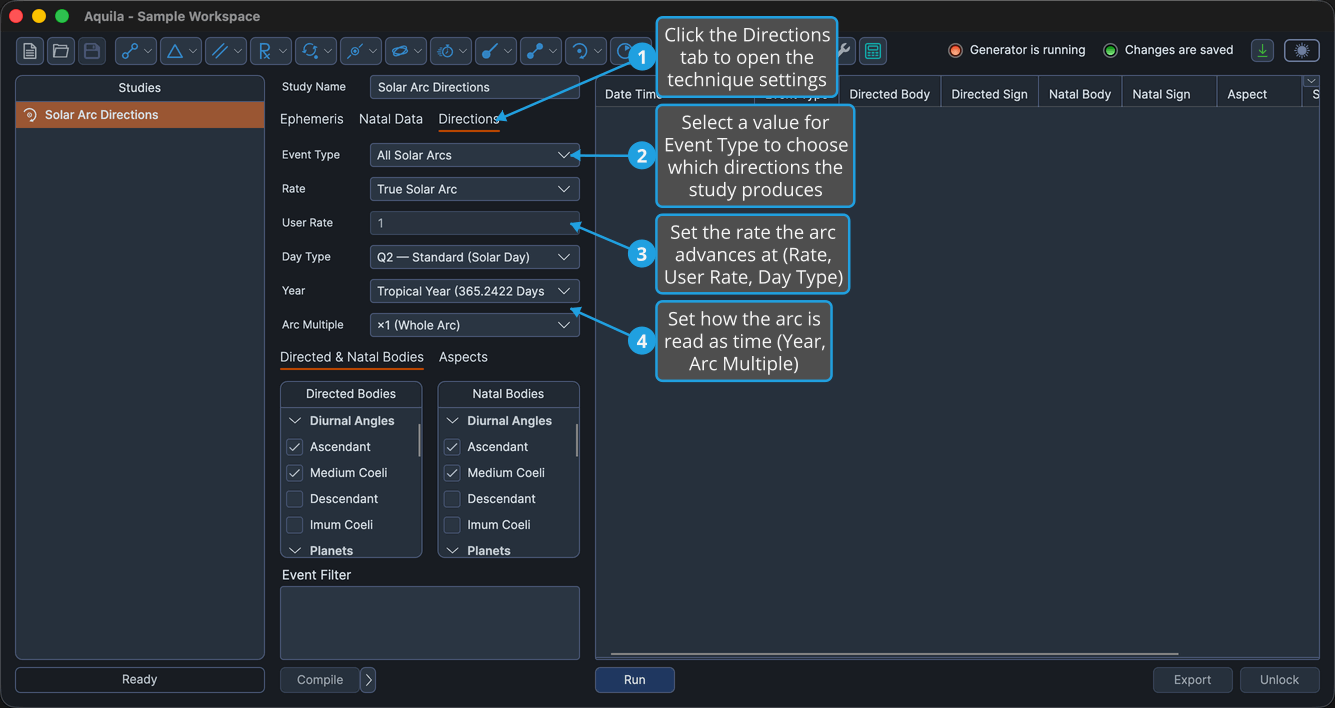
The Directions tab of the Solar Arc Directions Study holds the technique options: Rate, the User Rate box that goes with a user-defined rate, Day Type and Arc Multiple. The tab also carries the shared Event Type and Year drop-downs.
The arc's rate and the length of day it is measured over determine every directed date, so these settings state which convention the study works to before any events are generated.
Configure the Solar Arc Directions Technique
To state the conventions the study directs by:
- Click the Directions tab. The technique settings sit on their own tab of the study's settings column.
- Choose which directions the study produces: select a value for Event Type. This decides which directed contacts the study reports.
- State the rate the arc advances at. Select a Rate first, because it gates the two settings beside it: the User Rate box accepts the degrees of arc per year of life while the Rate is User-Defined Rate, and the Day Type drop-down accepts a value while the Rate is True Solar Arc. Together these three settle how far the solar arc moves for each year of life, and over what length of day a true arc is measured.
- State how the arc is read as time and how much of it is applied: select a Year reckoning and an Arc Multiple. The year reckoning turns arc into calendar dates; the arc multiple scales the arc before it is applied.
Technique Options
Each setting below shapes the arc the study applies to your directed points.
Rate
How much arc accrues per year of life. This is the study's central choice.
| Option | What It Means |
|---|---|
| True Solar Arc | The arc the secondary progressed Sun has traveled, that is, the Sun's position on the day-for-a-year clock less its natal position. Because the Sun's real motion varies through the year, this arc is specific to the natal record and slightly uneven. The modern standard and the default, the only rate the Day Type affects, and the only one that samples the ephemeris. |
| Naibod (59'08" per Year) | The Sun's mean motion, about 0.9856° per year, applied as a constant. It smooths out the seasonal variation of the true arc. |
| 1° per Year | Exactly one degree per year: the symbolic measure under which the arc in degrees is the age in years. |
| User-Defined Rate | A constant rate you supply yourself, in degrees per year, in the User Rate box. |
User Rate
The user-defined arc rate, in degrees per year of life. The box is enabled only when the Rate is User-Defined Rate and the study is unlocked, and it accepts values from 0.01 to 10. The rate must be greater than zero.
Day Type
Which day of ephemeris time stands for a year of life when the progressed Sun is sampled. The drop-down is enabled only when the Rate is True Solar Arc, because the three constant rates sample no progressed position and so the setting cannot reach them.
| Option | What It Means |
|---|---|
| Q2 — Standard (Solar Day) | One solar day stands for one year of life. The default. |
| Q1 — Bija (Sidereal Day) | One sidereal day stands for one year of life, shorter by a factor of 0.997269566. Preferred by practitioners working with the sidereal zodiac. |
Arc Multiple
A factor applied to the solar arc before it is added to the directed points. The six values are the multiples the technique uses.
| Option | What It Means |
|---|---|
| ×1 (Whole Arc) | The arc is applied unchanged. The default and the standard technique. |
| ×½ (Half Arc) | Half the arc. Part of the Uranian octave practice, in which a pair of points comes due when the arc reaches half their natal separation. |
| ×2 (Double Arc) | Twice the arc, the other half of the octave practice, in which a pair comes due when the arc reaches twice their separation. |
| ×−1 (Negative Arc) | The arc is subtracted from the natal positions instead of added. |
| ×−½ (Negative Half Arc) | Half the arc, subtracted. |
| ×−2 (Negative Double Arc) | Twice the arc, subtracted. |
A negative multiple is not the same thing as a converse direction, and the two compose freely. A converse direction measures its arc over the days before birth, whereas a negative multiple reverses an arc measured over the days after birth.
Event Type and Year
Two of the drop-downs on this tab are shared with other studies rather than belonging to the technique itself.
- Event Type chooses between all solar arcs, direct solar arcs only and converse solar arcs only. See Event Type Selection for the full list of values.
- Year fixes how long a year of life is when the elapsed years are turned into a date. It never changes a rate: Naibod and the true solar arc describe the Sun's real motion and keep their astronomical values under either reckoning. See Year Reckoning.
What the reckoning does change is how long a year of life is, so the same arc under the same rate falls about 1.5% earlier in life under the prophetic reckoning. The Age at Event column reports ages in the study's own reckoning.