Profections Study
Profection is a time-lord technique: it assigns each span of a life a ruling planet. The Profections study gives you the sign-change dates for a natal record and names the lord that each new period brings in, which is something the aspect-perfection studies cannot tell you.
A profected point advances one whole sign at a time, one sign per year of life, one further sign per profection month, and one further sign per day-period. Every jump does three things at once, and the study reports all three: it activates a sign, it activates the natal whole-sign house that sign occupies, and it makes that sign's ruler the Lord of the Period.
Create a Profections Study
To add a Profections study to the current workspace:
- Click Profections → Profections on the menu bar.
Alternatively, click the Profections drop-down button on the toolbar and select Profections from its flyout.
The new study appears at the bottom of the Studies list and is selected automatically, so its settings open immediately. It takes its name from the study type.
What This Study Finds
The study generates an event each time a profected point enters its next sign. These events are period boundaries rather than aspect perfections, so there is no Aspects table, no orb setting and no house-system control anywhere in the study: whole-sign counting is definitional, and none of the three would have anything to act on.
Three levels nest inside one another. The annual level advances the point one sign per profection year, the monthly level one further sign per profection month within that year, and the daily level one further sign per day-period within that month. Counts are cumulative down the cascade, and counting always runs forward in zodiacal order. Each level's sequence is generated from its parent's boundary instant and is cut off by the parent's next boundary, which is why a higher-level boundary also emits the lower-level events that coincide with it.
Boundary instants do not depend on which point is being profected. They are worked out once and shared across every selected point, so each additional point adds one event per boundary at essentially no further cost. Volume is dominated by the daily level: with the shipped defaults and every level enabled, a hundred-year range produces roughly 400 annual, 4,800 monthly and 146,000 daily events, and the Event Type setting is the control to reach for when only the higher levels are wanted.
The Zodiac setting is functional in this study, unlike in its direction and progression neighbors where it only relabels the output. Natal positions are sampled in the study's own zodiac, so each point profects from that zodiac's natal sign and a study set to the sidereal zodiac profects from the sidereal natal sign. Positions come from the natal record's own location, and the natal record's time zone governs the boundary arithmetic; the study's Location supplies only the time zone the resulting dates are shown in. Profections do not exist before birth, so a date range that starts earlier is clipped at the natal instant.
Settings are laid out on two tab controls. The upper one carries Ephemeris, Natal Data and Profections; the lower one carries a single Profected Points tab holding the one body list this study needs.
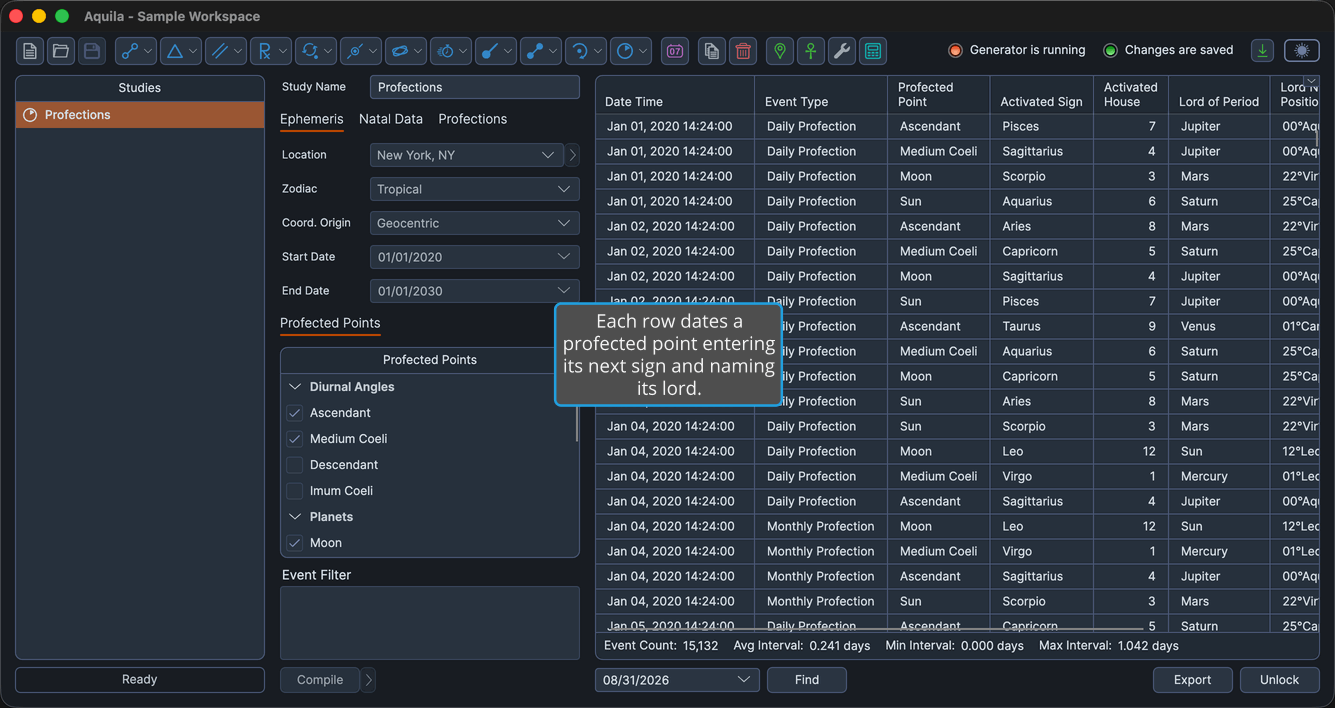
Events Table Columns
The events table shows the columns below. Several columns are hidden by default, as the table notes. Right-click any column header to show or hide a column, as described in Choose Events Table Columns.
| Column | Description |
|---|---|
| Date Time | The boundary instant, the moment the profected point jumps to the next sign, in the application's long date-time format. Always the first column, and it cannot be moved. Visible by default. |
| Event Type | Whether the row is an annual, monthly or daily profection. Visible by default. |
| Profected Point | The natal point being advanced. Visible by default. |
| Natal Position | That point's natal position as degrees, sign and minutes of the zodiac, the anchor its whole sequence counts from. Hidden by default. |
| Activated Sign | The sign the point has profected into. Visible by default. |
| Activated House | The natal whole-sign house that sign occupies, counted from the natal Ascendant's sign, as a whole number from 1 to 12. Visible by default. |
| Lord of Period | The activated sign's ruler under the selected Rulership Scheme, the Lord of the Year, Month or Day. Visible by default. |
| Lord Natal Position | The lord's own natal position as degrees, sign and minutes of the zodiac. Visible by default. |
| Lord Natal House | The lord's own natal whole-sign house, as a whole number. Hidden by default. |
| Period Number | The ordinal of the period: the year of life on an annual event, the month within the profection year on a monthly event, and the day-period within the profection month on a daily event. Visible by default. |
| Age | Decimal years of life at the boundary. Visible by default. |
| Event Interval | Elapsed time since the previous event in the list. Hidden by default. |
Period Number, not Age, carries the exact year of life. Under the On Birthday boundary a calendar year is 365 or 366 days against the mean tropical year the Age column counts in, so an annual event lands near its integer age without sitting exactly on it, and age 1 may read as 0.999. Reporting the lord's own natal placement alongside the activation is what lets you judge a period straight from the events table.