Primary Directions Study
Primary directions are the oldest and most exacting of the predictive timing techniques, and every school works them a little differently. The Primary Directions study dates them for a single natal record, to the method, frame and key your own practice uses.
Each event names a significator, a promissor and the aspect between them, and carries the arc of direction that was solved for alongside the age of life it falls at. Directions are exact by construction: there is no orb setting anywhere in the study, so an aspect either perfects at a solvable arc or it does not.
Create a Primary Directions Study
To add a Primary Directions study to the current workspace:
- Click Direction Studies → Primary Directions on the menu bar.
Alternatively, click the Direction Studies drop-down button on the toolbar and select Primary Directions from its flyout.
The new study appears at the bottom of the Studies list and is selected automatically, so its settings open immediately. It takes its name from the study type.
What This Study Finds
The study generates an event each time the diurnal rotation of the sphere, the apparent daily turning that carries the whole sky westward, brings a promissor or one of its aspect rays to the natal place of a significator. Two roles are involved in every direction. The significator is the passive point whose natal place is the target, traditionally a small set such as the Ascendant, the Midheaven, the Sun and the Moon. The promissor is the active point carried to that place, and its list is usually the wider of the two.
Unlike most studies in Aquila, this one solves rather than searches. For each combination of significator, promissor, aspect and direction type it solves the natal geometry once for a single quantity, the arc of direction measured in degrees of right ascension, and then converts that arc into an age using the selected Key. Two things follow from that. The date range acts as a filter rather than a search window, so widening it costs nothing and never slows generation. And how long generation takes depends on the two body lists and the aspect angles alone, never on the length of the date range: a one-year range and a two-hundred-year range take the same time.
The geometry comes from the natal record rather than from the study's own Location. The arc depends on the geographic latitude of the birthplace and on the right ascension of the meridian at the birth moment, so the Location supplies only the time zone the resulting dates are shown in. Some combinations have no solution at all, a circumpolar point has no semi-arc and so cannot be directed by the Placidian method, and rather than dropping those silently the study records each one with a reason and reports a summary once generation completes.
Settings are laid out on two tab controls. The upper one carries Ephemeris, Natal Data and Directions; the lower one carries Significators & Promissors and Aspects. The Ephemeris tab hides its Reference Plane row, because an arc of direction is measured in right ascension whichever plane the study reports in. Each event instead carries both frames, giving every point its longitude and sign position alongside its right ascension and declination.
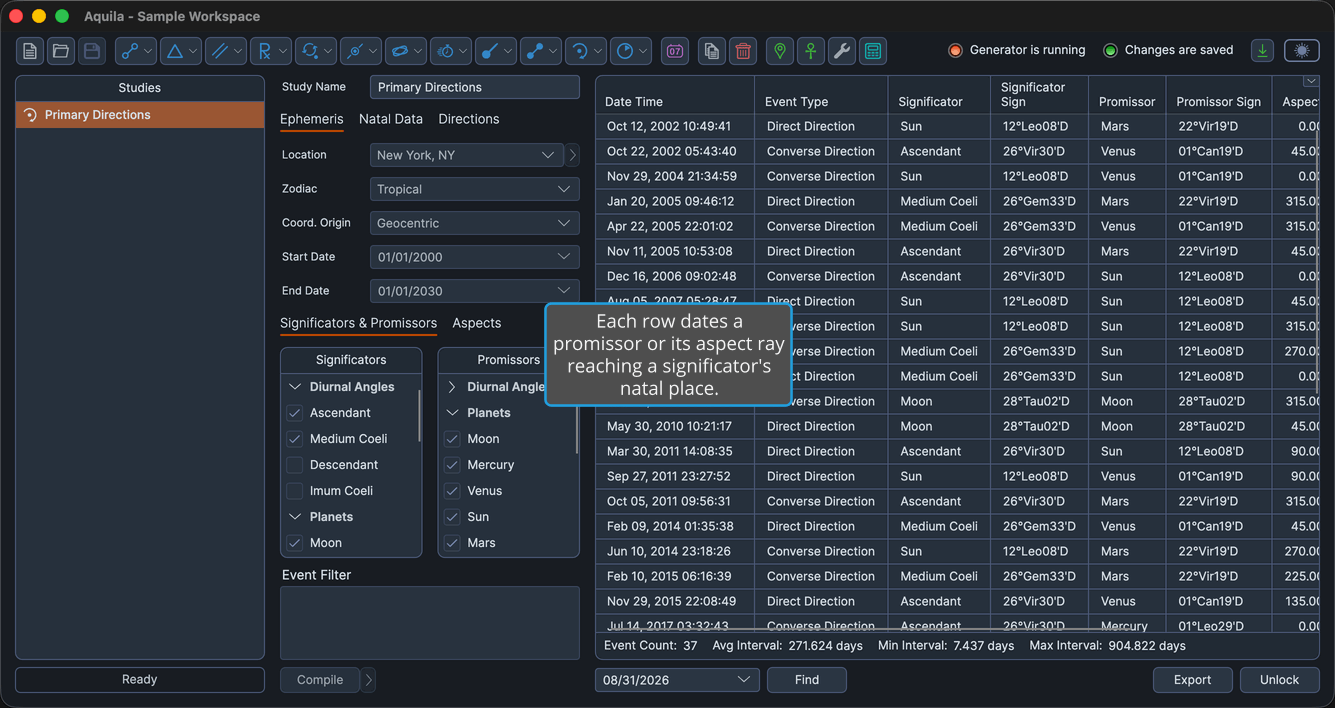
Events Table Columns
The events table shows the columns below. Several columns are hidden by default, as the table notes. Right-click any column header to show or hide a column, as described in Choose Events Table Columns.
| Column | Description |
|---|---|
| Date Time | The date the direction perfects, in the application's long date-time format. Always the first column, and it cannot be moved. Visible by default. |
| Event Type | Whether the row is a direct direction or a converse direction. Visible by default. |
| Significator | The natal point whose place the direction is aimed at. Visible by default. |
| Significator Longitude | The significator's natal ecliptic longitude in degrees. Hidden by default. |
| Significator Sign | The significator's natal position as degrees, sign and minutes of the zodiac. Visible by default. |
| Significator Latitude | The significator's natal ecliptic latitude in degrees. Hidden by default. |
| Significator Right Asc | The significator's natal right ascension in degrees. Hidden by default. |
| Significator Declination | The significator's natal declination in degrees. Hidden by default. |
| Promissor | The point carried to the significator's natal place. Visible by default. |
| Promissor Longitude | The promissor's natal ecliptic longitude in degrees. Hidden by default. |
| Promissor Sign | The promissor's natal position as degrees, sign and minutes of the zodiac. Visible by default. |
| Promissor Latitude | The promissor's natal ecliptic latitude in degrees. Hidden by default. |
| Promissor Right Asc | The promissor's natal right ascension in degrees. Hidden by default. |
| Promissor Declination | The promissor's natal declination in degrees. Hidden by default. |
| Aspect | The cycle angle applied to the promissor, in degrees. Visible by default. |
| Arc of Direction | The solved arc, in degrees of right ascension. Negative on a direction that falls before birth, and on every modern converse direction. Visible by default. |
| Age at Event | Elapsed years of life at the direction, counted in the study's Year reckoning. Visible by default. |
| Event Interval | Elapsed time since the previous event in the list. Hidden by default. |