Midpoint Aspects Study
A Midpoint Aspects study tells you when a planet reaches a sensitive midpoint between two others. Create the study from the Mundane Studies menu, check the aspecting bodies and the midpoint bodies, list the aspect angles in its Aspects table, and click Run to generate the events.
Overview
A Midpoint Aspects study finds the moments when a transiting body forms an exact aspect to the near midpoint of two other transiting bodies. The aspecting body is checked in the Aspecting Bodies list. The midpoint belongs to a pair made of one body checked in the Inner Bodies list and one checked in the Outer Bodies list. The aspect is one of the angles listed in the study's Aspects table. Each event is one exact aspect within the study's date range, dated in the time zone of the study's location.
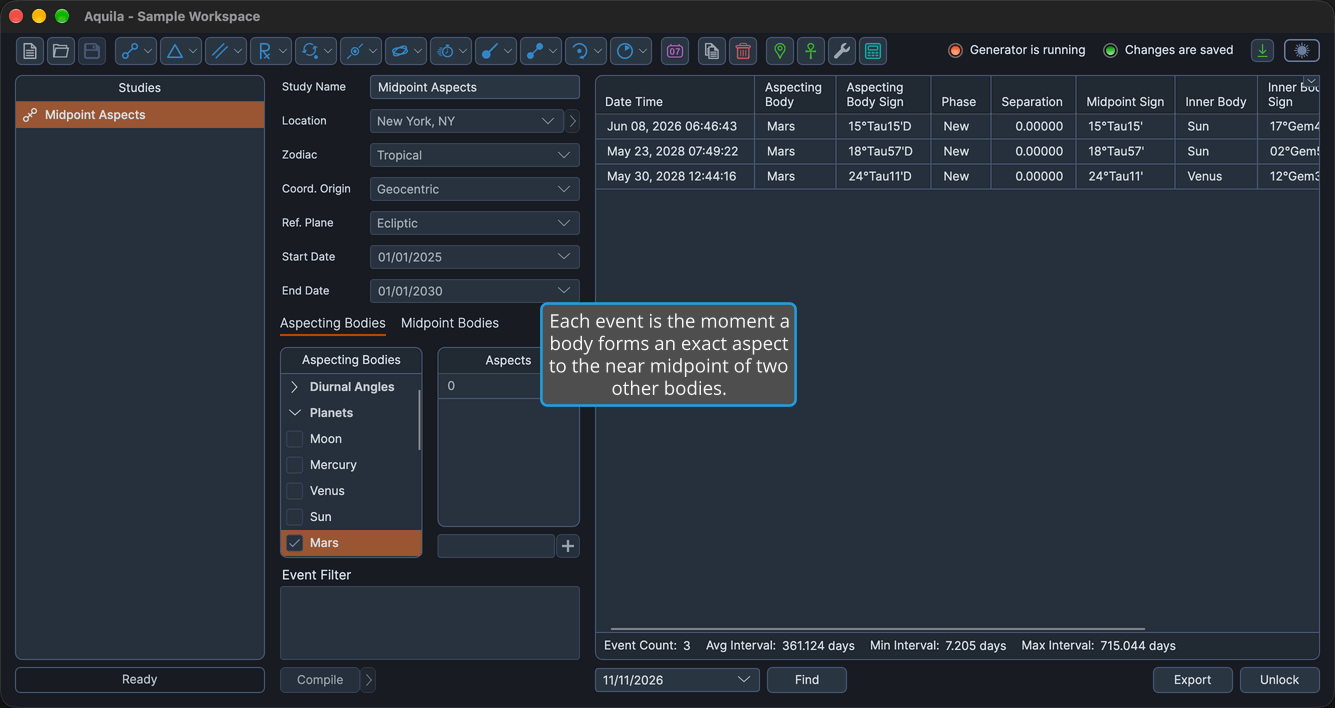
The study's bodies and aspects sit on two tabs below its ephemeris settings and date range:
- Aspecting Bodies: the Aspecting Bodies list beside the Aspects table, which lists the aspect angles as cycle angles in degrees.
- Midpoint Bodies: the Inner Bodies and Outer Bodies lists, whose pairs form the midpoints.
To set up the bodies and the aspects, see Bodies List and Aspects Table; the other settings are described under Study Configuration. To fill the events table, see Generate Events.
Create a Midpoint Aspects Study
Add a new Midpoint Aspects study to your workspace from the menu bar. You can create a study whenever a workspace is open and is not being saved or loaded. On macOS the Mundane Studies menu is on the menu bar at the top of the screen; on Windows the menu bar is inside the Aquila window.
- Click Mundane Studies on the menu bar.
- Click Aspects in the Mundane Studies menu.
- Click Midpoint Aspects in the Aspects submenu.
The new study is named after its type, added at the end of the Studies list and selected. Its settings come from the workspace defaults and the default presets, and the workspace has unsaved changes. For more about new studies, see Create Study.
The toolbar offers the same study: click the Aspect Studies drop-down button, which shows the Mundane Aspects icon, and choose Midpoint Aspects. On Windows, you can also create the study from the keyboard by pressing Alt+M, A and I in turn.
Events Table Columns
Each event fills one row of the study's events table. A Midpoint Aspects study has these 26 columns, in the order Aquila creates them. Headers are shown as they read under the Ecliptic reference plane; the description of a column that changes under the Equatorial plane gives its Equatorial header. To show or hide a column, right-click any column header (Toggle Column Visibility).
| Column | Description | Default Visibility |
|---|---|---|
| Date Time | Date and time of the event in the time zone of the study's location, in the long date and time format. Always the first column: it cannot be dragged, and it returns to first place if another column is dropped in front of it. | Visible |
| Aspecting Body | Name of the transiting body that aspects the midpoint. | Visible |
| Aspecting Body Longitude | Longitude of the aspecting body, in degrees (0 to 360). Under the Equatorial plane: right ascension, headed Aspecting Body Right Asc. | Hidden |
| Aspecting Body Sign | Zodiac sign position of the aspecting body (degree, sign and minute, with a D or R motion marker where the body's motion is shown). Unavailable under the Equatorial plane: the column is hidden and disabled in the column menu, and if it was showing, the Aspecting Body Longitude column appears in its place. | Visible |
| Aspecting Body Latitude | Latitude of the aspecting body, in degrees. Under the Equatorial plane: declination, headed Aspecting Body Declination. | Hidden |
| Aspecting Body Distance | Distance of the aspecting body, in AU. | Hidden |
| Aspecting Body Speed | Speed of the aspecting body in longitude, in degrees per day. Under the Equatorial plane: speed in right ascension. | Hidden |
| Cycle Angle | Cycle angle of the aspect, in degrees (0 to 360). | Hidden |
| Phase | Phase of the aspect, derived from the cycle angle: New, Waxing, Full or Waning. | Visible |
| Separation | Angular separation of the aspect, in degrees (0 to 180): the shorter way around the cycle angle. | Visible |
| Midpoint Longitude | Longitude of the near midpoint of the inner and outer bodies, in degrees (0 to 360). Under the Equatorial plane: right ascension, headed Midpoint Right Asc. | Hidden |
| Midpoint Sign | Zodiac sign position of the near midpoint of the inner and outer bodies (degree, sign and minute, with a D or R motion marker where the motion is shown). Unavailable under the Equatorial plane: the column is hidden and disabled in the column menu, and if it was showing, the Midpoint Longitude column appears in its place. | Visible |
| Midpoint Speed | Rate of change of the midpoint's longitude, in degrees per day (the mean of the pair's rates). | Hidden |
| Inner Body | Name of the inner body of the pair. | Visible |
| Inner Body Longitude | Longitude of the inner body, in degrees (0 to 360). Under the Equatorial plane: right ascension, headed Inner Body Right Asc. | Hidden |
| Inner Body Sign | Zodiac sign position of the inner body (degree, sign and minute, with a D or R motion marker where the body's motion is shown). Unavailable under the Equatorial plane: the column is hidden and disabled in the column menu, and if it was showing, the Inner Body Longitude column appears in its place. | Visible |
| Inner Body Latitude | Latitude of the inner body, in degrees. Under the Equatorial plane: declination, headed Inner Body Declination. | Hidden |
| Inner Body Distance | Distance of the inner body, in AU. | Hidden |
| Inner Body Speed | Speed of the inner body in longitude, in degrees per day. Under the Equatorial plane: speed in right ascension. | Hidden |
| Outer Body | Name of the outer body of the pair. | Visible |
| Outer Body Longitude | Longitude of the outer body, in degrees (0 to 360). Under the Equatorial plane: right ascension, headed Outer Body Right Asc. | Hidden |
| Outer Body Sign | Zodiac sign position of the outer body (degree, sign and minute, with a D or R motion marker where the body's motion is shown). Unavailable under the Equatorial plane: the column is hidden and disabled in the column menu, and if it was showing, the Outer Body Longitude column appears in its place. | Visible |
| Outer Body Latitude | Latitude of the outer body, in degrees. Under the Equatorial plane: declination, headed Outer Body Declination. | Hidden |
| Outer Body Distance | Distance of the outer body, in AU. | Hidden |
| Outer Body Speed | Speed of the outer body in longitude, in degrees per day. Under the Equatorial plane: speed in right ascension. | Hidden |
| Event Interval | Days elapsed since the previous event in the list, to three decimal places. Empty on the first event. | Hidden |