Transiting Aspects Study
Transits to the natal positions are the most widely used predictive technique, and a Transiting Aspects study gives you exact dates for the contacts between the transiting bodies and the natal bodies you follow.
The study generates an event each time a transiting body forms an exact aspect to a natal body. Every event records the transiting body, the natal body it aspects, the angle between them and the moment the aspect perfects.
Create a Transiting Aspects Study
To add a Transiting Aspects study to the current workspace:
- Click Transit Studies → Transiting Aspects on the menu bar.
Alternatively, click the Aspect Studies drop-down button on the toolbar and select Transiting Aspects from its flyout.
The new study appears at the bottom of the Studies list and is selected automatically, so its settings open immediately. It takes its name from the study type.
What This Study Finds
Transiting Aspects is a transiting study rather than an activation study, and the distinction decides what counts as an event. Here the natal body is one end of the aspect itself: a natal body is required to complete the contact, and no event exists without one. In an activation study such as Aspect Activations, by contrast, the aspect is formed by transiting bodies in their own right, and the natal body is engaged separately by a transiting body that is in contact with it.
The angles the study looks for are the cycle angles held in its Aspects table. That table carries angles alone and no orbs of its own, so an event is generated at the moment the cycle angle between the transiting body and the natal body exactly matches one of the angles you have entered. The Transit Orb, on the Natal Data tab, sets how close a transiting body must be to the natal body for the contact to register. See Orb Settings for how the orb fields behave.
The settings column lays the study out on two tab controls. The first carries an Ephemeris tab holding the shared ephemeris settings and date-range panels, and a Natal Data tab holding the natal record fields and the Transit Orb. The second carries a Transiting Bodies & Aspects tab holding the Transit. Bodies list and the Aspects table, and a Natal Bodies tab holding the Natal Bodies list.
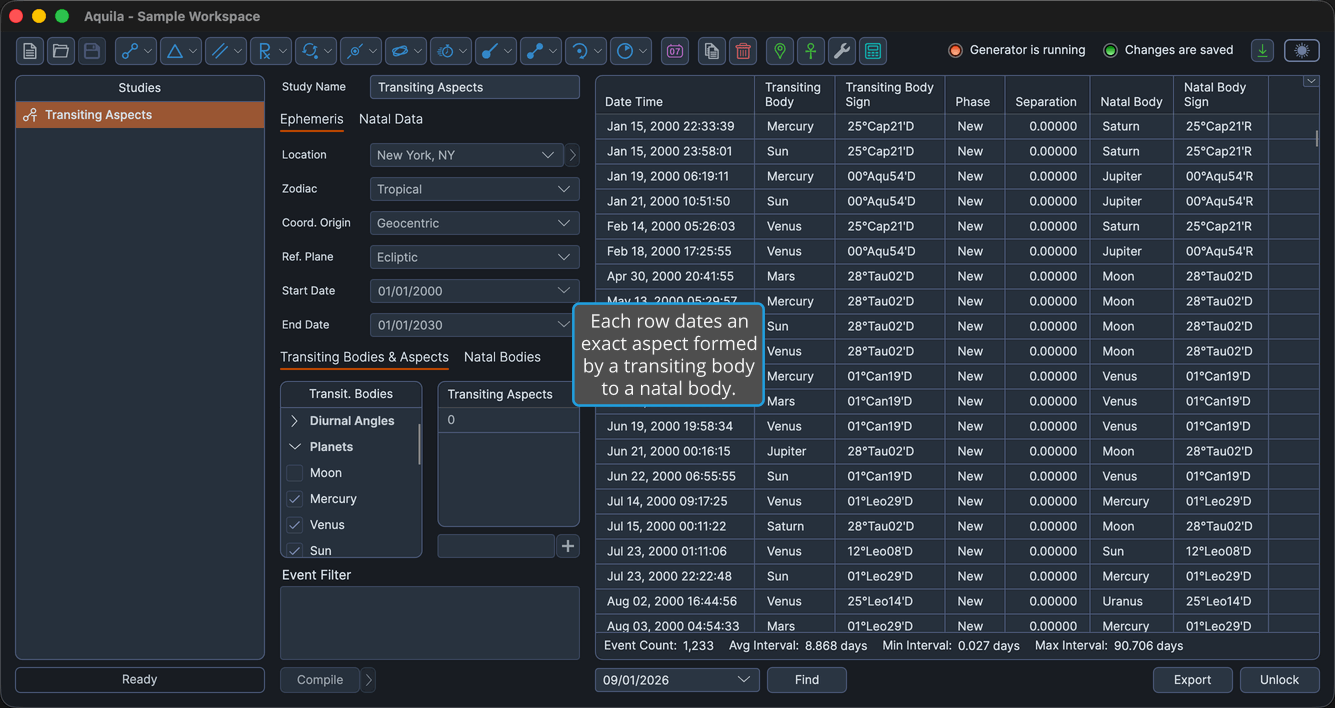
Events Table Columns
The events table shows the columns below. Several columns are hidden by default, as the table notes. Right-click any column header to show or hide a column, as described in Choose Events Table Columns. The headers of the coordinate columns follow the study's Reference Plane: they read Longitude and Latitude in the ecliptic plane, and Right Asc and Declination in the equatorial plane. The ecliptic-plane header text is listed here.
| Column | Description |
|---|---|
| Date Time | Date and time the aspect perfects, in the application's long date-time format. Always the first column, and it cannot be moved. Visible by default. |
| Transiting Body | Name of the transiting body. Visible by default. |
| Transiting Body Longitude | Primary coordinate in degrees. Hidden by default. |
| Transiting Body Sign | Position as degrees, sign and minutes of the zodiac. Visible by default. |
| Transiting Body Latitude | Secondary coordinate in degrees. Hidden by default. |
| Transiting Body Distance | Radial distance in astronomical units (AU). Hidden by default. |
| Transiting Body Speed | Speed in degrees per day. Hidden by default. |
| Cycle Angle | The cycle angle that was matched between the transiting body and the natal body, in degrees. Hidden by default. |
| Phase | Aspect phase: New, Waxing, Full or Waning. Visible by default. |
| Separation | Angular separation between the transiting body and the natal body, in degrees. Visible by default. |
| Natal Body | Name of the natal body. Visible by default. |
| Natal Body Longitude | Primary coordinate in degrees. Hidden by default. |
| Natal Body Sign | Position as degrees, sign and minutes of the zodiac. Visible by default. |
| Natal Body Latitude | Secondary coordinate in degrees. Hidden by default. |
| Natal Body Distance | Radial distance in astronomical units (AU). Hidden by default. |
| Natal Body Speed | Speed in degrees per day. Hidden by default. |
| Event Interval | Elapsed time since the previous event in the list. Hidden by default. |